humanoid robots teleoperated by human surgeons removed gallbladders from live pigs, the firs...
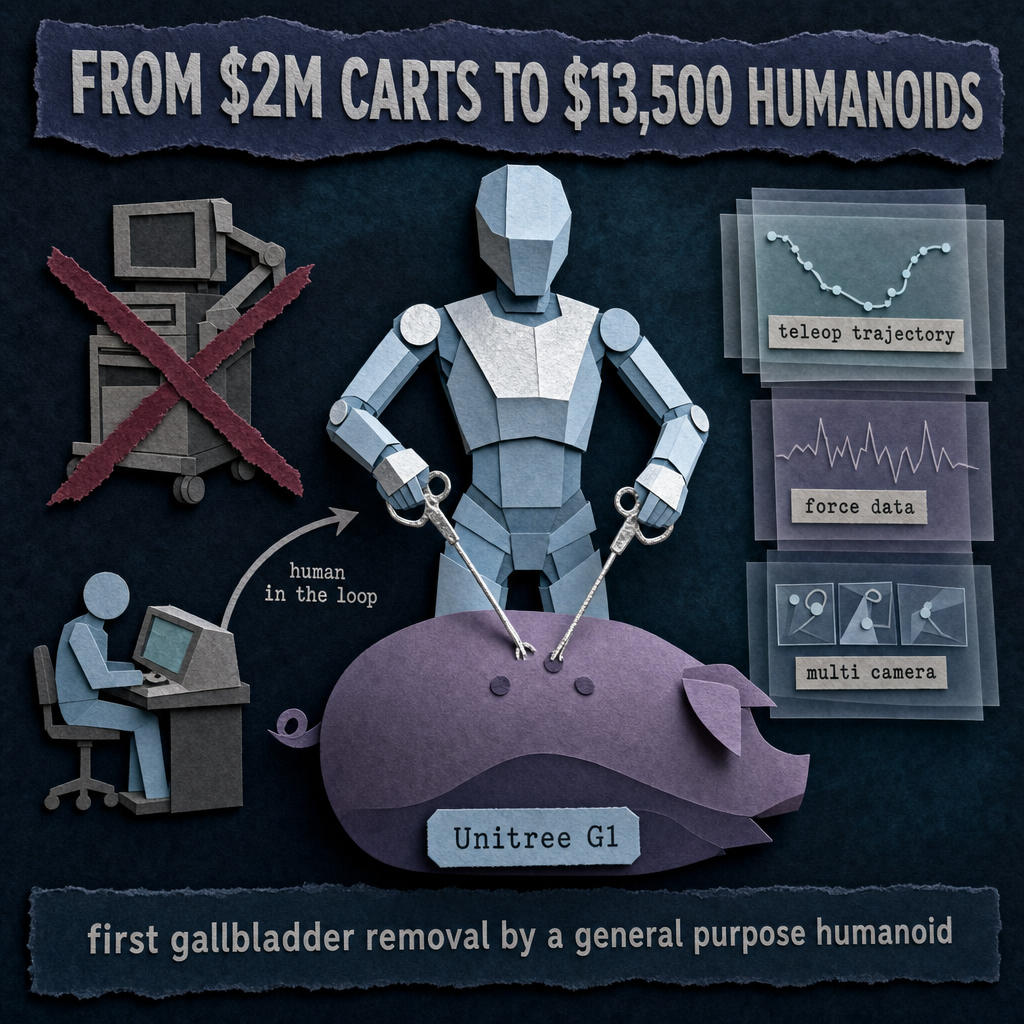
Today's development to watch in robotics: humanoid robots teleoperated by human surgeons successfully removed gallbladders from live pigs. It's the first end to end surgical procedure completed by a general purpose humanoid rather than a dedicated surgical robot costing upwards of 2 million dollars, and it hints at a structural shift in how medical robotics might be built and sold.
The setup is worth pausing on. The rig is a Unitree G1 humanoid, a platform with a starting price around 13,500 dollars, outfitted with standard laparoscopic tools and driven by a surgeon working at a teleoperation console. There is no autonomy in the loop yet. This is a human in the loop pilot, not an AI surgeon, and that distinction matters for how we interpret what was demonstrated. The novelty is the hardware substrate, not the intelligence layer.
Technically, this challenges a long standing assumption in the operating room. Traditional surgical robots like the da Vinci system are purpose built cart systems that require a dedicated OR footprint, careful calibration, and a maintenance contract that effectively rules out smaller hospitals and clinics in lower income regions. A general purpose humanoid collapses that fixture. The same platform that sutures today could restock a supply room tomorrow, and, more importantly, could learn from teleoperation demonstrations for later semi autonomous use. The economics move by roughly two orders of magnitude, which is the kind of gap that reshapes procurement decisions rather than just improves them.
The layer worth watching, especially for builders, is not the arms. It's the data. Every teleoperated procedure is a labeled, force annotated, multi camera trajectory of expert human motion in a high stakes environment. That is exactly the substrate that imitation learning stacks like LeRobot and RT style policies are hungry for. Surgery, in this framing, just became a high value data collection program disguised as a clinical trial. The clinical outcome pays for the data, and the data compounds into future policies.
The broader arc looks like this: expensive task specific robots are being unbundled into cheap general hardware plus a growing pile of teleoperation trajectories that will eventually train the next generation of policies. Whether the first fully autonomous surgical humanoid arrives in five years or fifteen is less interesting than the fact that the data pipeline for it is now quietly under construction inside real operating rooms. The next signals to track are which hospital systems sign on, how regulators frame teleoperated humanoids relative to existing surgical robot categories, and how quickly the first published policies trained on this kind of data appear.
Originally posted on LinkedIn.