Anthropic published research showing Claude has an internal "J-space", a small, emergent wor...
Official source: https://www.anthropic.com/research/global-workspace
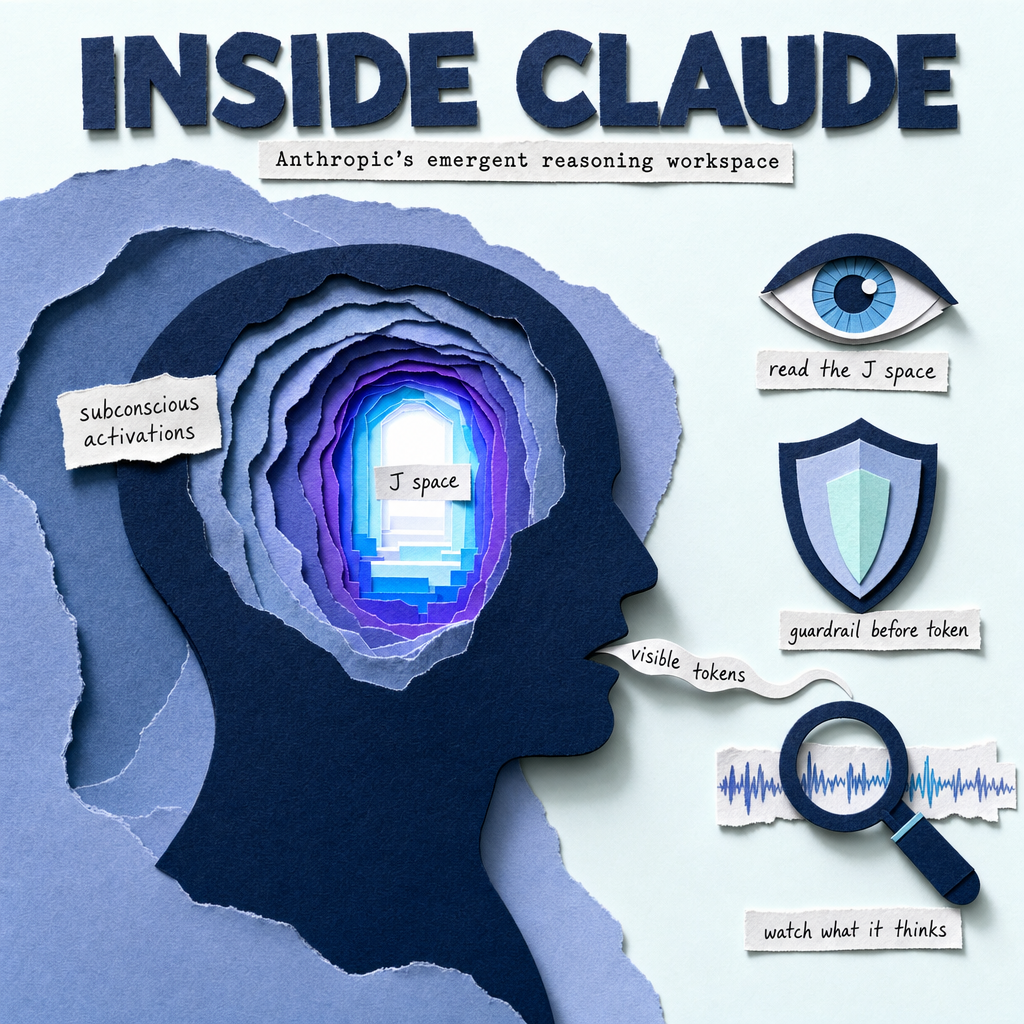
Anthropic just published research describing something called J space inside Claude, a small internal workspace where the model appears to run silent multi step reasoning before producing a single output token. If that holds up, it changes how anyone building on top of these models should think about evaluation, monitoring, and what "alignment" even means at inference time.
The finding is that this workspace was not designed. It emerged on its own during training. When Anthropic's researchers ablate it, casual chat still works, but multi step reasoning collapses to below the performance of their smallest model. The structure lines up neatly with Global Workspace Theory from neuroscience, the idea that most cognition happens subconsciously while a narrow channel holds whatever is currently in focus. Seeing that same shape appear inside a transformer, without anyone building it in, is a meaningful data point about how these systems actually organize computation.
For builders, the implication is that chain of thought was never the whole story. The visible reasoning tokens are a projection of something happening underneath, and the real work lives in activations you never see. That gap is exactly why prompt only evaluations keep missing failure modes, and why a model can produce text that looks aligned while its internal trajectory is pointed somewhere else. Anyone who has stress tested a production LLM has probably felt this without having a name for it. The output reads clean, the behavior in the wild is off.
The practical shift is that interpretability stops being a research curiosity and starts becoming production tooling. If you can read the J space, you can monitor for goal drift, tool misuse, or deceptive reasoning before the output token is ever emitted. That is a real guardrail layer, not a regex on the response string. It also suggests a very different architecture for AI observability platforms, one where the signal being watched is internal state rather than final text, closer to profiling a running process than reading its logs.
The thing worth watching next is whether this generalizes. Anthropic found J space in Claude, but if similar workspaces exist across other frontier models, and if reading them can be standardized, we are looking at the beginning of a real interpretability stack that sits alongside prompts, evals, and RAG in the builder toolkit. Evaluating only what the model says is now officially insufficient. The next generation of observability will need to watch what it thinks, and the teams that figure out how to do that cleanly will have a durable advantage over teams still grading transcripts.
Originally posted on LinkedIn.