Apptronik just opened a 90,000 square foot "Robot Park" in Austin where Apollo 2 humanoids r...
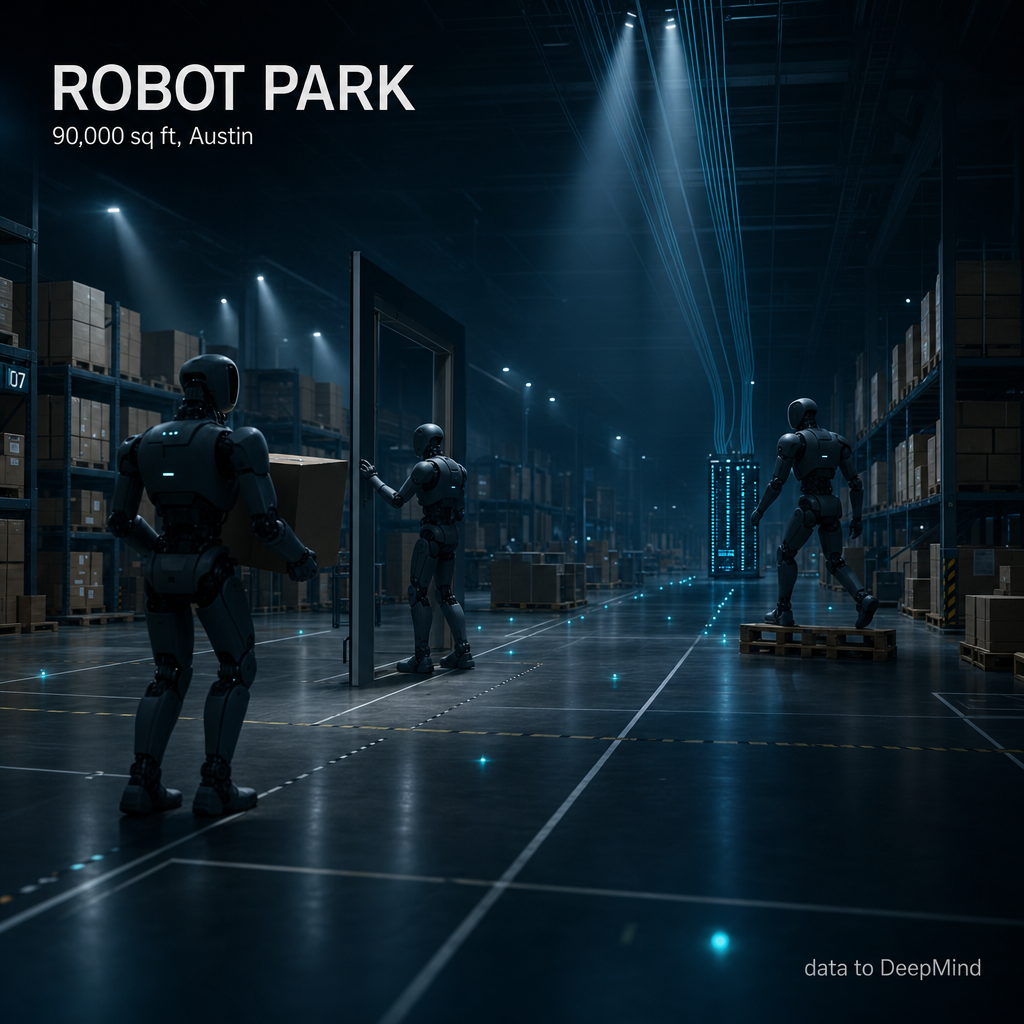
Apptronik just opened a 90,000 square foot facility in Austin called Robot Park, where Apollo 2 humanoids run logistics, retail, and manufacturing tasks on a continuous loop and pipe the resulting data straight into Google DeepMind. This is the piece humanoid robotics has been quietly missing, and it changes how to evaluate every company in the space.
The demo reel era of humanoid robotics is ending. Every startup can show a curated clip of a robot folding laundry or handing over a bottle, but almost none of them operate a closed loop data factory that produces training data at industrial scale. Apptronik CEO Jeff Cardenas said the quiet part out loud, admitting the whole industry, his own company included, has mostly been shipping prototypes. Robot Park is the pivot away from that. It runs both bipedal and wheeled Apollo 2 units, some teleoperated and some autonomous, generating real world repetitions on tasks like picking boxes, opening doors, and crossing uneven floors. Those trajectories flow into the DeepMind partnership that is training the next generation Apollo 3.
The technical reason this matters comes down to a hard constraint in modern robotics. There is no internet scale corpus for manipulation. You cannot scrape grasping the way you scrape text or images, because the data simply does not exist in a form a model can consume. Every viable foundation model for physical tasks needs a purpose built data engine with three ingredients: teleoperation to bootstrap early behaviors, autonomous execution to scale the volume, and task diversity to force generalization across environments. Tesla built this loop for driving with its fleet. Apptronik is building the humanoid version, and the DeepMind collaboration means the resulting dataset is not staying inside one company's silo.
For anyone evaluating humanoid vendors right now, whether as an investor, a warehouse operator, or an engineer picking a platform to build on, the competitive moat is not the model architecture or the elegance of the gait controller. Those things converge quickly across the industry. The moat is who owns the physical facility, who designs the task curriculum, and who runs the annotation pipeline that feeds the training loop week after week.
The interesting question over the next twelve to eighteen months is whether other humanoid companies follow this template or try to shortcut it with synthetic data and simulation. Simulation helps, but sim to real gaps remain stubborn for contact rich manipulation. The players who commit early to physical data factories, unglamorous as they are compared to a viral demo, are the ones likely to have functioning general purpose humanoids in commercial deployment first.
Originally posted on LinkedIn.