Anthropic shipped Claude Sonnet 5 as its new default, priced at $2/$10 per million tokens th...
Official source: https://www.anthropic.com/news/claude-sonnet-5
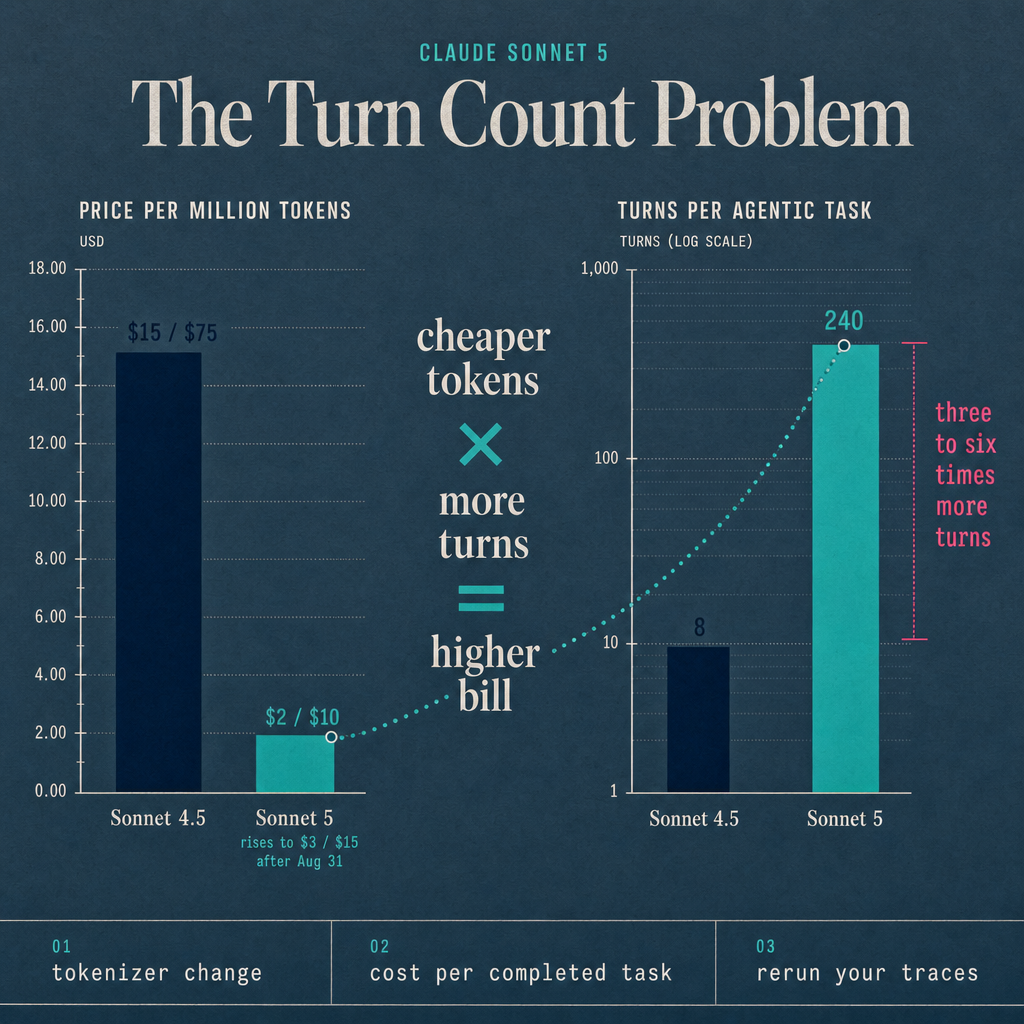
Anthropic released Claude Sonnet 5 as its new default model this week, and on paper the pricing looks like a straight win for anyone running agents. The catch is that the sticker price and the actual bill are moving in opposite directions, and builders who route on list price alone are going to be surprised by their invoices.
Sonnet 5 launched at 2 dollars per million input tokens and 10 dollars per million output tokens, promotional pricing that holds through August 31 before rising to 3 and 15 respectively. On the same day, the U.S. Department of Commerce lifted export controls on Fable 5 and Mythos 5 after an 18 day pause, which is its own story but worth noting as part of the broader shift in how frontier models are being priced and distributed globally. The interesting part is what happened underneath the model itself.
The technical story is not the benchmark bump. It is the turn count. Early reports from AINews and hands on practitioners show Sonnet 5 taking three to six times more turns than Sonnet 4.5 on the same agentic tasks, driven in part by a tokenizer change. Cheaper per token, but more tokens per job, and more round trips through your tool graph. On agent loops that browse the web, call tools, and edit code, the actual bill can climb even as the per token price falls. Every extra turn also means more latency, more chances for a tool call to fail, and more state to manage in the loop.
For builders, this rewires the eval harness. Cost per task, not cost per million tokens, is the number that matters. If you route based on list price alone, Sonnet 5 looks like a free upgrade over 4.5. If you route based on end to end task cost with your real tool graph and your real prompts, it might not be. This is also a reminder that tokenizer changes are not cosmetic. They ripple through context windows, prompt caching hit rates, and the economics of every agent framework built on top.
The broader pattern worth watching is that per token pricing is becoming a weaker signal of what any given model actually costs to run in production. As agents get more autonomous and loops get longer, the unit of measurement has to move up a level, from tokens to completed tasks. Rerun your agent traces this week before flipping the default. Measure turns, cache hits, and total spend per completed task, and let those numbers, not the launch post, decide which model sits behind your production traffic.
Originally posted on LinkedIn.