Meta just shipped Brain2Qwerty v2, a non-invasive brain-to-text model that hit 61 percent wo...
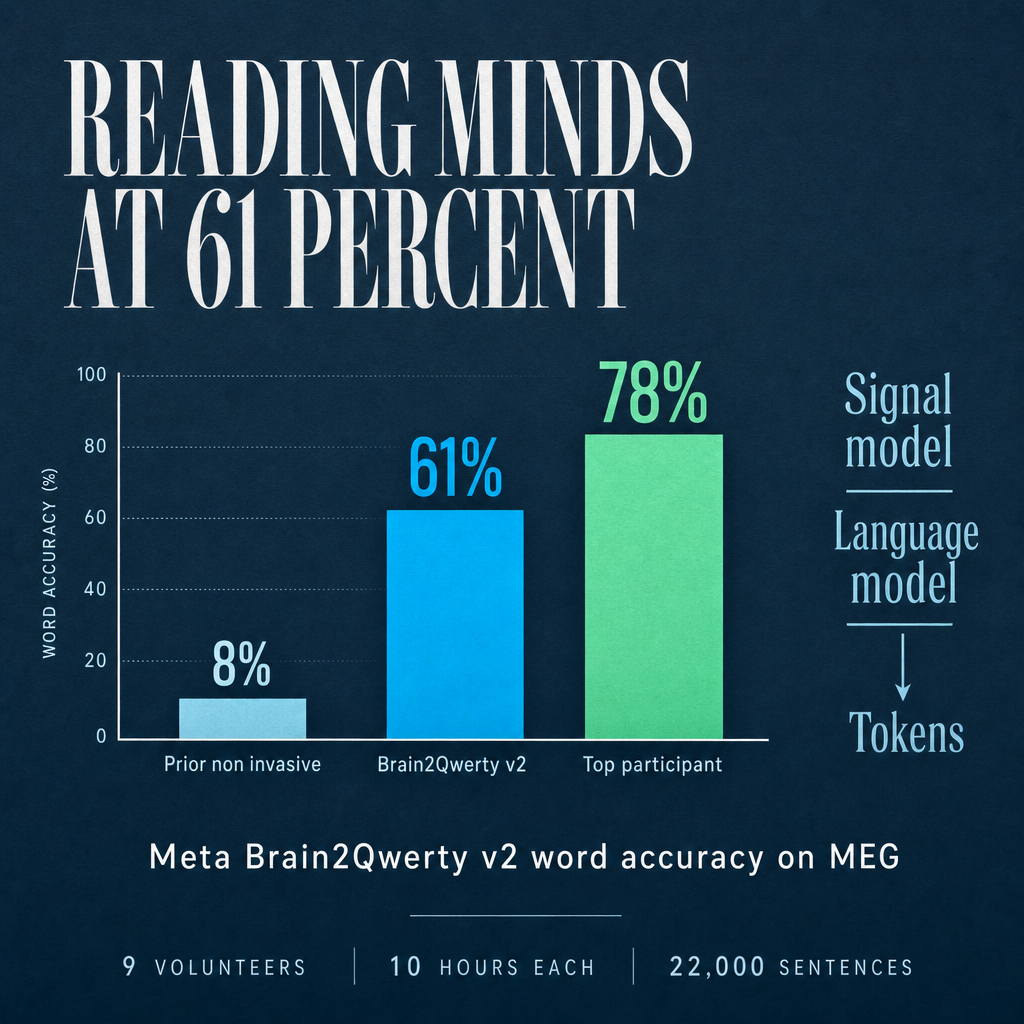
Meta has released Brain2Qwerty v2, a non invasive brain to text system that reads sentences directly off a magnetoencephalography scan and decodes them with 61 percent word accuracy. That number matters because the previous ceiling on non invasive decoding sat around 8 percent, and the new result starts to approach what surgical implants achieve without anyone needing to cut open a skull.
The study ran nine volunteers through an MEG scanner for 10 hours each, during which they typed roughly 22,000 sentences. Two models worked in tandem during decoding. The first reads the raw magnetic signals produced as the participant types. The second adds semantic context to clean up the output. The top participant landed at 78 percent word accuracy, which suggests the ceiling is mostly a function of signal quality per person rather than a hard limit of the method. Meta open sourced both the v1 and v2 training code, and the Basque Center on Cognition, Brain and Language released the v1 dataset, so other groups can build on this without redoing the expensive scanner time.
The architectural choice is the part worth dwelling on. This is not one giant end to end model trained to map brain signals to text. It is a two stage decoder. A signal model handles the noisy sensor stream coming out of the MEG, and a language model handles meaning. That is the same split we already use in modern speech recognition, where an acoustic model feeds a language model, and the same pattern as retrieval pipelines, where an embedding model feeds an LLM. The perception layer and the reasoning layer get to scale on their own data curves rather than competing for capacity inside a single network. Meta also noted that accuracy keeps climbing as recording hours go up, which implies the signal model is still data limited rather than architecture limited.
For people building products outside neuroscience, the lesson is not really about brain computer interfaces. It is that pairing a domain specific encoder with a general purpose LLM is now beating monolithic models across yet another modality. Sensor in, tokens out, LLM cleans up the rest.
What I will be watching is how quickly this template gets applied to cheaper sensors. MEG scanners cost millions and require shielded rooms, so 61 percent accuracy in a lab is a research milestone, not a consumer product. The interesting question is whether the same two stage approach holds up on EEG, which is portable and affordable, even if the raw signal is much noisier. If it does, the timeline for practical assistive typing devices shortens considerably, and a lot of the long standing assumptions about needing implants to get usable bandwidth start to look shakier.
Originally posted on LinkedIn.