Qwen just dropped AgentWorld, a 35B open-weight model that simulates the environments agents...
Official source: https://huggingface.co/Qwen
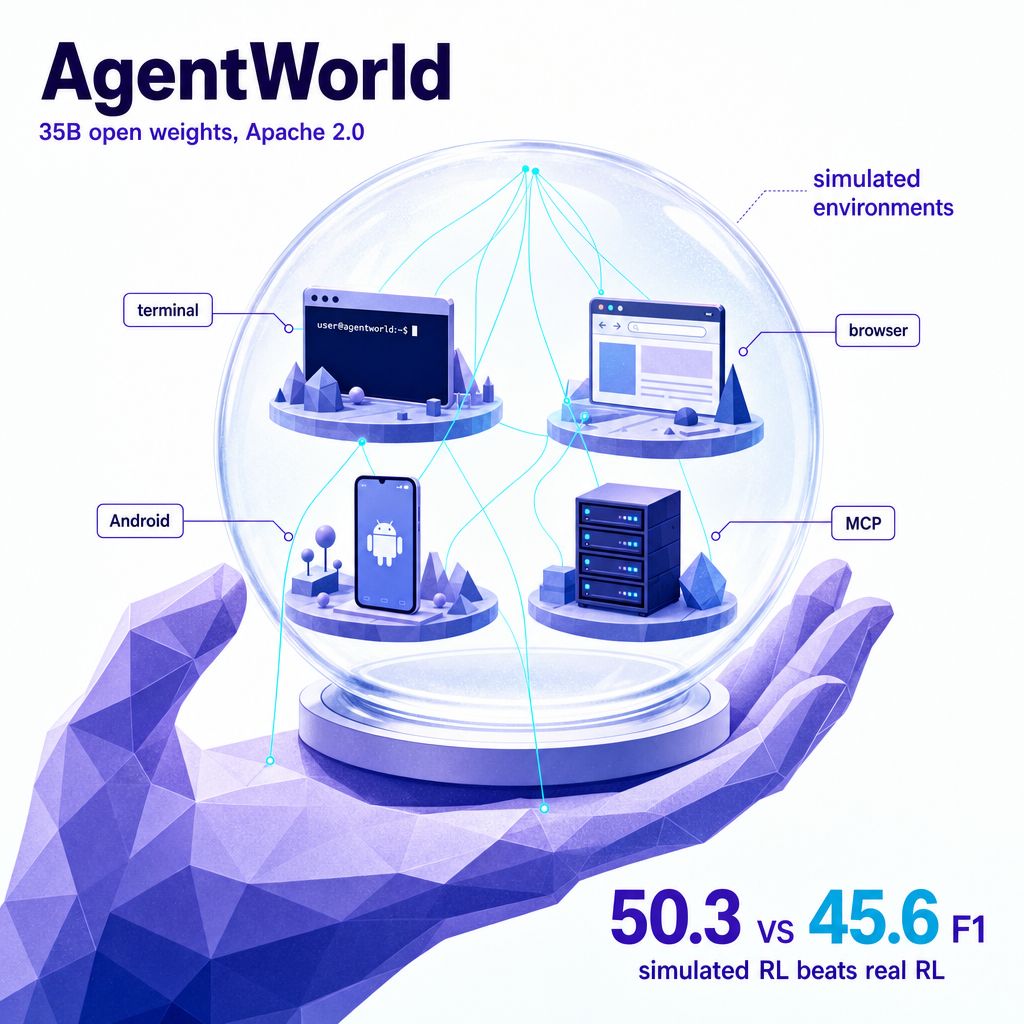
Alibaba's Qwen team has open sourced AgentWorld, a 35 billion parameter model that does not act as an agent but simulates the environments agents act inside. It is on HuggingFace under Apache 2.0, runs on vLLM today, and it quietly reframes how agent training pipelines might be built going forward.
Until now, training an agent meant spinning up real sandboxes. Actual shells for terminal tasks, actual Chromium for browser tasks, actual Android emulators for mobile agents, actual MCP servers for tool use. These environments are slow, expensive, flaky, and hard to parallelize across thousands of rollouts. AgentWorld replaces that infrastructure with prediction. Given any action an agent takes, the model returns what the environment would have returned. Think of it as a flight simulator for tool calls, where the simulator is itself a language model trained to be faithful to terminal output, DOM state, Android UI, and server responses.
The numbers are what make this more than a curiosity. Reinforcement learning conducted entirely inside the simulator scored 50.3 percent F1 on live search tasks, compared to 45.6 percent for an identical RL setup trained against real environments. Simulated training beat real training. AgentWorld also tops AgentWorldBench against GPT 5.4 and Anthropic's Claude Opus 4.8, which is a meaningful position for an open weight model in a category that has been dominated by frontier closed systems.
For people actually building agents, the practical implication is concrete. If you are running evals or RL rollouts against live APIs right now, you are burning tokens, hitting rate limits, and dealing with non determinism on every single trajectory. A learned world model is now a credible substitute for the inner loop of that process. The natural pattern is to use AgentWorld for exploration, curriculum design, and bulk training, and reserve real environments for final validation runs where fidelity to production behavior actually matters. That changes the cost structure of agent research from infrastructure heavy to inference heavy, which is a problem the field already knows how to solve.
The deeper point is about what was actually scarce. Compute has been plentiful for a while. What gated agent training was reliable, resettable, parallelizable environments, and the engineering effort to maintain them. By absorbing that work into a model, AgentWorld makes the bottleneck cheaper in a way that compounds. Worth watching closely is whether the simulator's gains transfer cleanly to harder environments like long horizon coding agents or multi step financial workflows, and whether other labs release their own environment models. If they do, the next generation of agent benchmarks may be defined as much by simulator quality as by the agents themselves.
Originally posted on LinkedIn.