Anthropic shipped Claude Tag, turning Claude into a tagged Slack teammate that breaks work i...
Official source: https://www.anthropic.com/news/introducing-claude-tag
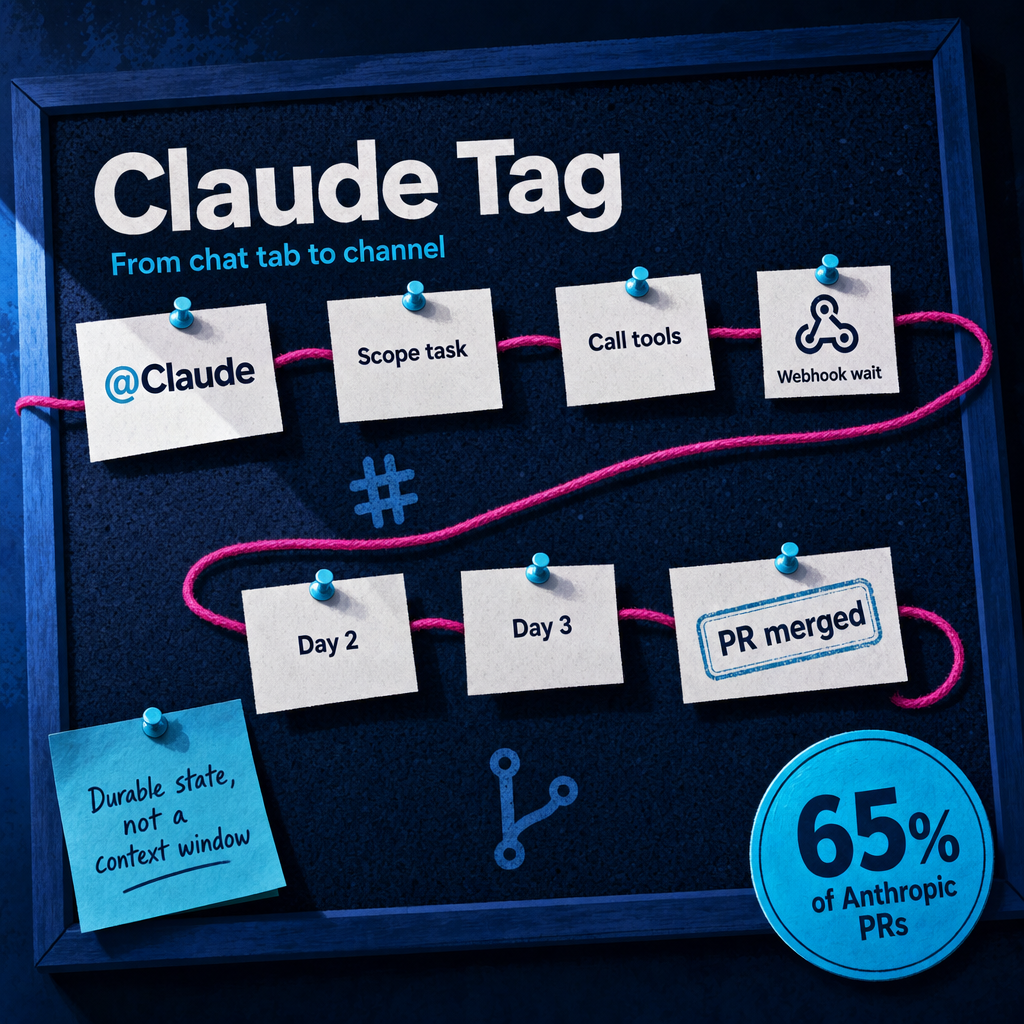
Anthropic released Claude Tag this week, a feature that turns Claude into a tagged Slack participant capable of running multi day tasks inside the channels where teams already coordinate. The detail worth pausing on is that Anthropic says Claude Tag now merges 65 percent of its own product pull requests, which means an agent embedded in Slack is doing real engineering work end to end at the company that built it.
The mechanics matter. You mention Claude in a channel, it scopes the task into stages, calls approved tools, pings the human owner of any dependent code, then reports back asynchronously. It can wait on git webhooks for days before resuming, which is the part that breaks the old mental model of an agent as a chat session. Claude can also run in an ambient mode, watching threads and surfacing summaries with action items without being explicitly tagged. The runtime has moved from a chat tab to the channel where work already happens, and that relocation changes what an agent actually is.
For builders, three architectural consequences follow. First, the unit of agent execution is no longer a session, it is a long running task with webhook triggers and multi day wait states. Your orchestration layer needs durable state, persistent task identifiers, and resumability, not just a large context window. Second, identity and permissions now span Slack, GitHub, and internal tools simultaneously, which means the auth surface effectively becomes the product. Getting OAuth scopes, role boundaries, and audit trails right is no longer a deployment detail, it is the core engineering problem. Third, evaluation gets harder. Whether the agent shipped the pull request matters more than token level accuracy, and observability has to follow a single task across multiple systems and multiple days. Traditional LLM eval harnesses were not designed for this shape.
The broader pattern is that agent form factors keep migrating toward where the work and the humans already are. The IDE was the previous frontier, with Copilot and Cursor pulling generation into the editor. The channel is the next one, because most cross functional work is coordinated in chat, not in a code window. What I will be watching over the next few quarters is whether other labs and platforms follow Anthropic into this same shape, and whether the durable task primitive becomes a standard part of agent frameworks rather than something each team rebuilds. If 65 percent PR merge rates hold up outside Anthropic's own walls, the channel native agent stops being a novelty and starts being the default deployment target.
Originally posted on LinkedIn.