Sakana AI launched Fugu, a model that doesn't generate tokens itself, it routes every reques...
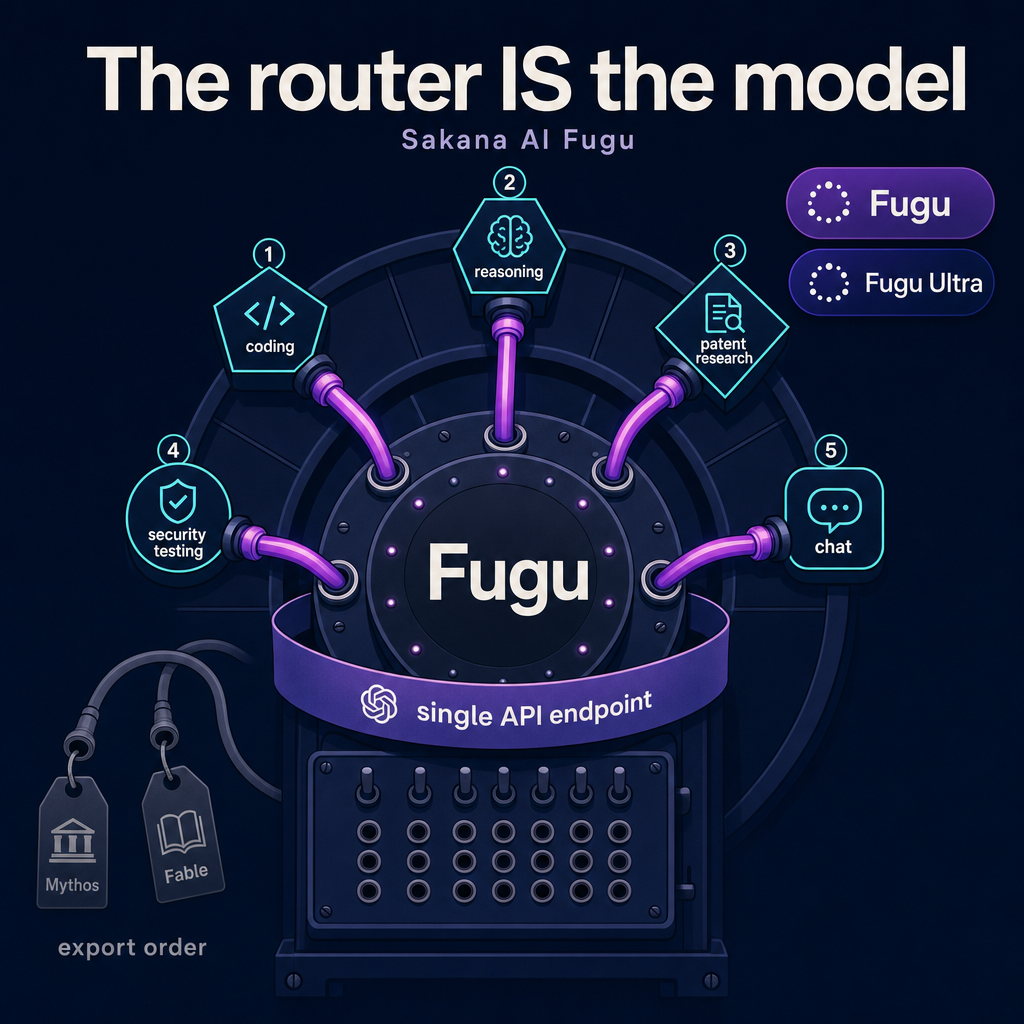
Sakana AI released Fugu this week, a model that does not generate tokens at all. Instead, it routes every request to a pool of specialist models behind a single OpenAI compatible API, and the company claims parity with Anthropic's Mythos and Fable on coding and reasoning benchmarks. For anyone building on closed weights right now, that framing matters more than any single benchmark number.
The way Fugu works is straightforward in concept. The core model picks helpers, assigns subtasks, verifies outputs, and merges answers into a final response. Two tiers ship at launch. A fast Fugu handles chat and everyday coding workloads, while Fugu Ultra targets heavier jobs like patent research and security testing. The same endpoint shape developers already use for GPT class APIs covers both, which keeps integration cost near zero for teams that want to try it.
The architectural shift here is worth sitting with. For roughly two years, the industry default has been one large model behind one endpoint, with the provider doing all the hard work inside their own datacenter and exposing a single completion call. Fugu inverts that pattern. Orchestration becomes the product, and the router is the model. The timing is not accidental. The recent US export order that pulled Mythos and Fable from several markets gave every team that built on a single provider a hard lesson in vendor concentration risk. A router that can swap leaf models without changing the calling code is a direct hedge against that kind of disruption, whether the disruption comes from policy, pricing, or a model getting deprecated.
For builders, this also changes the cost model in a quiet but meaningful way. You stop picking a model per task inside your own application code. You hand the routing decision to a layer that sees the incoming request, the latency budget, and the live pool of available models. Your evaluation work shifts up the stack. Instead of benchmarking each leaf model against each task, you benchmark the router itself on end to end outcomes. That is a different skill, closer to systems work than to prompt engineering, and most teams do not yet have the tooling for it.
What I am watching next is whether the major labs respond by shipping their own routing layers, or whether independent orchestrators like Fugu carve out the middle of the stack permanently. If the router becomes the durable interface, the leaf models start to look more like interchangeable compute, and the economics of foundation model training look very different a year from now. That is a bigger story than any single launch, and Fugu is the first product that makes it concrete.
Originally posted on LinkedIn.