John Jumper, the Nobel laureate behind AlphaFold, just left Google DeepMind for Anthropic, d...
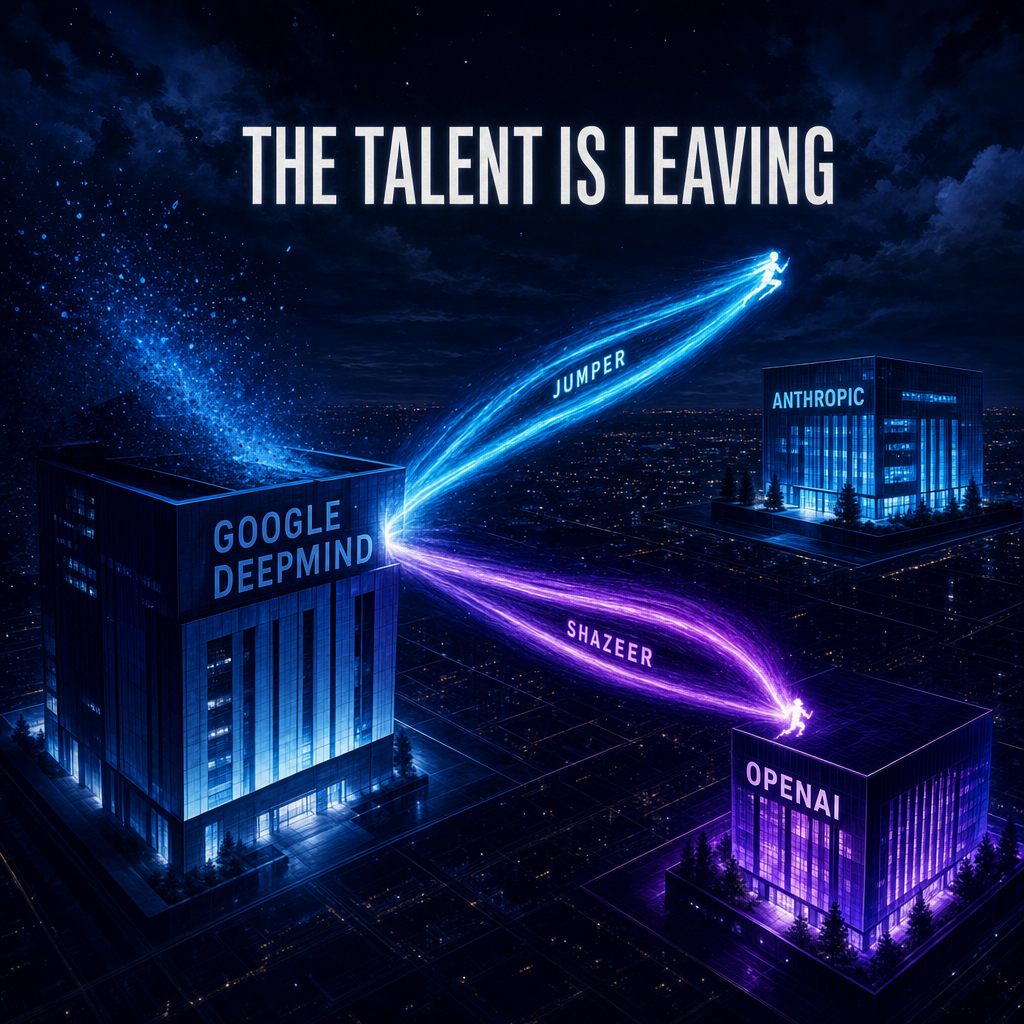
In the span of a single week, two of the most consequential researchers in modern AI walked out of Google. John Jumper, the Nobel laureate behind AlphaFold, left Google DeepMind for Anthropic. Days earlier, Noam Shazeer, co-author of the 2017 paper "Attention Is All You Need" that introduced the transformer architecture, defected to OpenAI. For a company that has spent the last decade positioning itself as the intellectual home of frontier AI, losing both names in the same news cycle is hard to read as anything other than a structural shift.
The numbers around these departures make them stranger, not more explainable. Google paid roughly 2.7 billion dollars two years ago to bring Shazeer back from Character.AI, a deal widely understood as an acqui-hire engineered specifically to retain him. Jumper spent nine years at DeepMind co-building the system that won a Nobel Prize in chemistry, the kind of career capstone that usually anchors a researcher to an institution for life. Neither stayed. That tells you something about what large packages and prestige actually buy in this market, which is a retention window, not loyalty. When the window closes, the researcher walks.
The technical implication is worth sitting with. For most of the last decade, the assumption inside the industry was that compute and proprietary data were the scarce inputs, and talent followed the GPUs. The Jumper and Shazeer moves invert that. Anthropic and OpenAI are now actively pulling in the exact people who shaped the previous decade of breakthroughs at Google, from transformer design to protein structure prediction. The frontier appears to follow the researchers, and the researchers are choosing smaller, more focused labs over the company that trained them.
For builders, this changes how to read provider risk. If you are picking a foundation model partner for a multi-year roadmap, with fine-tuning pipelines, eval harnesses, and inference contracts tied to a specific provider, talent flow becomes a leading indicator of which lab ships state of the art next. Capability leadership in this field has historically rotated on roughly 12 to 18 month cycles, and the researchers driving those cycles are visible in advance if you watch hiring announcements carefully.
What I will be watching over the next few quarters is whether this becomes a pattern or stays an anomaly. If a third or fourth senior DeepMind researcher makes a similar move, the conversation shifts from individual recruiting wins to a real question about whether Google can hold the institutional density it built. The labs that win the next phase may not be the ones with the most chips, but the ones the best researchers actually want to stay at.