Midjourney, the text-to-image company, just announced a full-body ultrasound scanner.
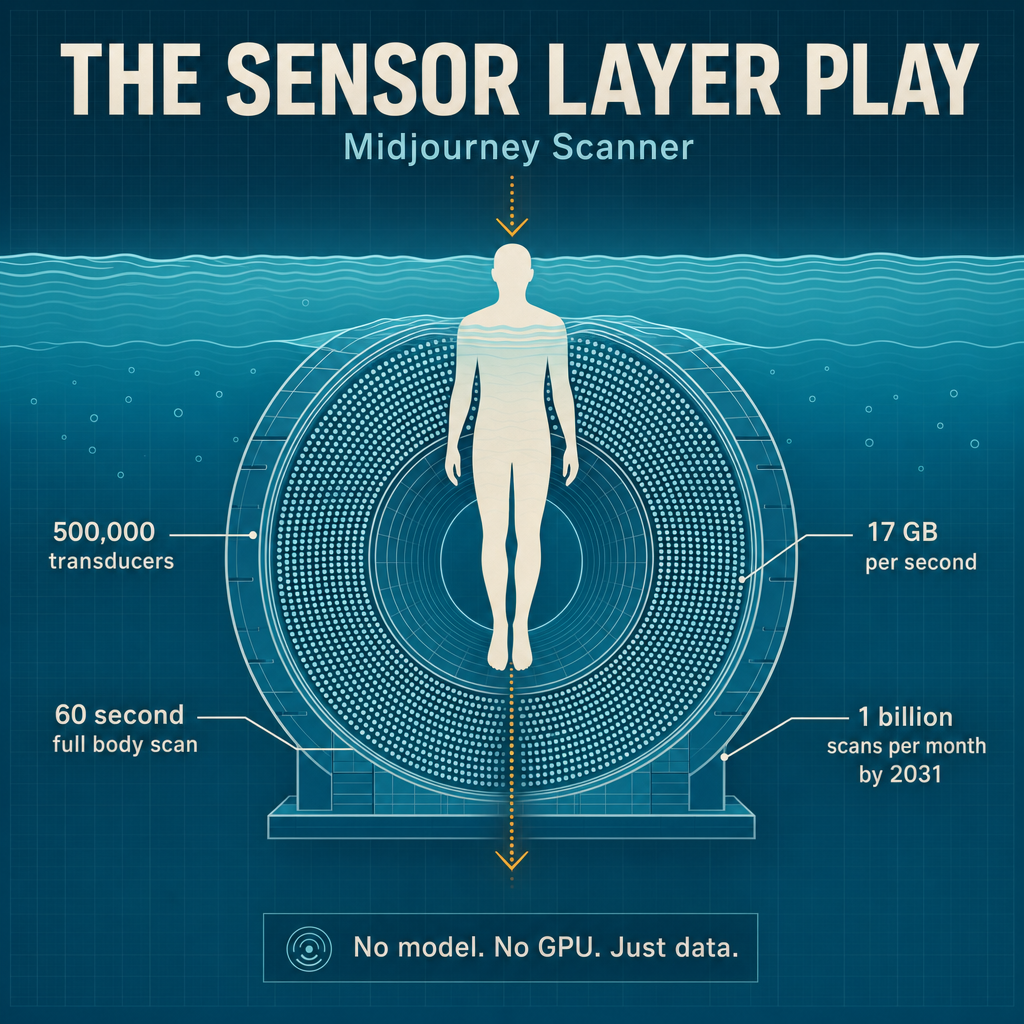
Midjourney, the company best known for turning text prompts into images, just announced a full body ultrasound scanner. It has no GPU, no model, and no AI in the device itself, which makes the move stranger and more interesting than a typical AI company hardware launch.
The Midjourney Scanner lowers a person through a ring of 500,000 ultrasound transducers submerged in water. It streams about 17 GB per second of acoustic data and reconstructs a 3D body map in 60 seconds at a few dollars per scan. Founder David Holz claims the detail will be comparable to MRI, which is a serious claim given that MRI is the reference standard for soft tissue imaging and typically costs hundreds to thousands of dollars per scan. The first location opens inside a San Francisco spa in 2027, with 50,000 units targeted globally and a stated goal of one billion scans per month by 2031. That last number is the one to sit with. A billion scans per month would be roughly an order of magnitude more medical imaging volume than the entire current global radiology pipeline produces.
The architecture is the genuinely interesting part. Beamforming and reconstruction from massive sensor arrays is a dense signal to image inverse problem, exactly the class of problem generative imaging teams have spent years solving for natural images. The math that turns noisy diffusion latents into coherent pictures has real overlap with the math that turns raw acoustic returns into volumetric anatomy. So Midjourney is not really pivoting away from its core competency. It is applying it to a new signal domain. And critically, the company is not shipping a medical model. It is shipping the data acquisition layer that future medical foundation models will train on. Whoever owns the sensor owns the corpus.
The broader read for anyone building in vertical AI is that the next defensible position may not be the weights. Open weights are getting better and cheaper every quarter, and a fine tune of a strong base model is a weekend of work for a competent team. What is not commoditizing is access to data that physically does not exist yet because no one has built the instrument to capture it. Tesla figured this out with driving video. Waymo figured it out with lidar. Midjourney appears to be making the same bet on human anatomy. The regulatory path is going to be brutal, the spa launch is clearly a way to sidestep the FDA on day one, and the 2031 numbers are aspirational at best. But the underlying thesis, that the moat in applied AI is shifting from model to sensor, is worth taking seriously regardless of whether this specific scanner ships on time.
Originally posted on LinkedIn.