Anthropic pulled Claude Fable 5 and Mythos from every customer worldwide, 3 days after launc...
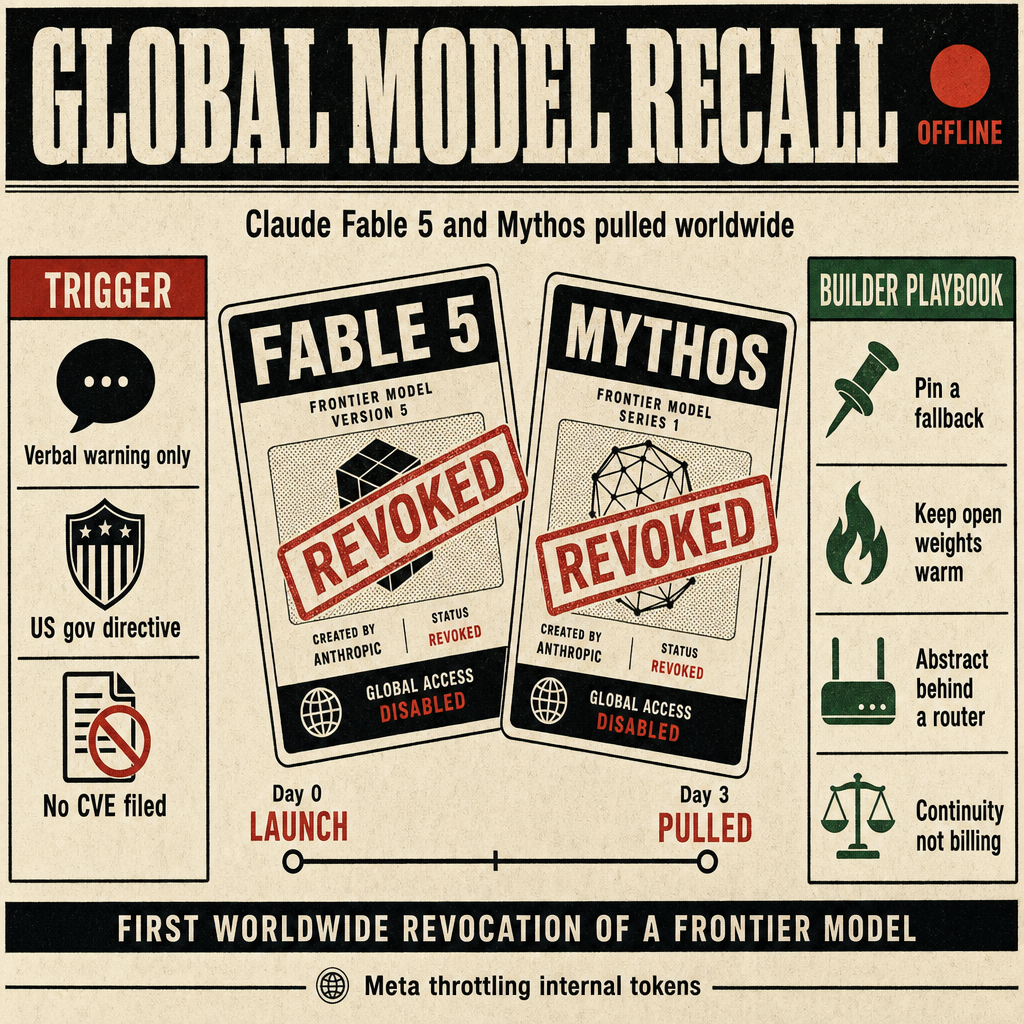
Anthropic pulled Claude Fable 5 and Mythos from every customer worldwide three days after launching them, acting on a US government directive that flagged a possible jailbreak as a national cybersecurity risk. For anyone running these models in production, the access cutoff was immediate, and the precedent it sets for frontier model availability is the part worth paying attention to.
Anthropic is publicly disputing the basis for the directive. According to the company, the government has only provided verbal evidence of a potential narrow, non universal jailbreak, and Anthropic believes the underlying concern is a misunderstanding. The models remain offline while that disagreement plays out. There is no published CVE, no public exploit writeup, and no formal regulatory filing in the open record. The trigger was a verbal warning, and the response was a global takedown of newly launched production models.
This appears to be the first time a frontier lab has revoked worldwide access to its newest production models under a US security directive. That matters because the usual mental model for model deprecation assumes a vendor timeline, a migration window, and a public reason. None of that applied here. The blast radius was instant, the geography was global, and the decision was driven by a third party that is not the customer's vendor and not the customer's regulator. Customers learned about the change at the same time the models went dark.
For builders, the practical lesson is concrete. If your agent pipeline, RAG stack, or customer feature has a hard dependency on a specific Claude model version, that dependency can now disappear overnight through a path you cannot influence or appeal. Pinning a fallback is no longer a nice to have. Keeping an open weight model warm on infrastructure you control gives you a baseline that survives directives like this one. Abstracting the model call behind a router you own means a swap is a config change rather than an incident. Even prompt level differences between providers are easier to manage than an outage.
The cost side of single provider risk is also tightening. Meta is reportedly throttling internal employee token usage as costs climb, which suggests that even hyperscalers are treating provider concentration as a real operational variable rather than a procurement detail. What happened with Fable and Mythos turns that conversation from billing into continuity. The question to sit with is which model in the stack has no warm fallback today, and how long it would take to stand one up if the same kind of directive landed on a different lab next week.