Anthropic shipped Claude Fable 5, and the headline is not the benchmark.
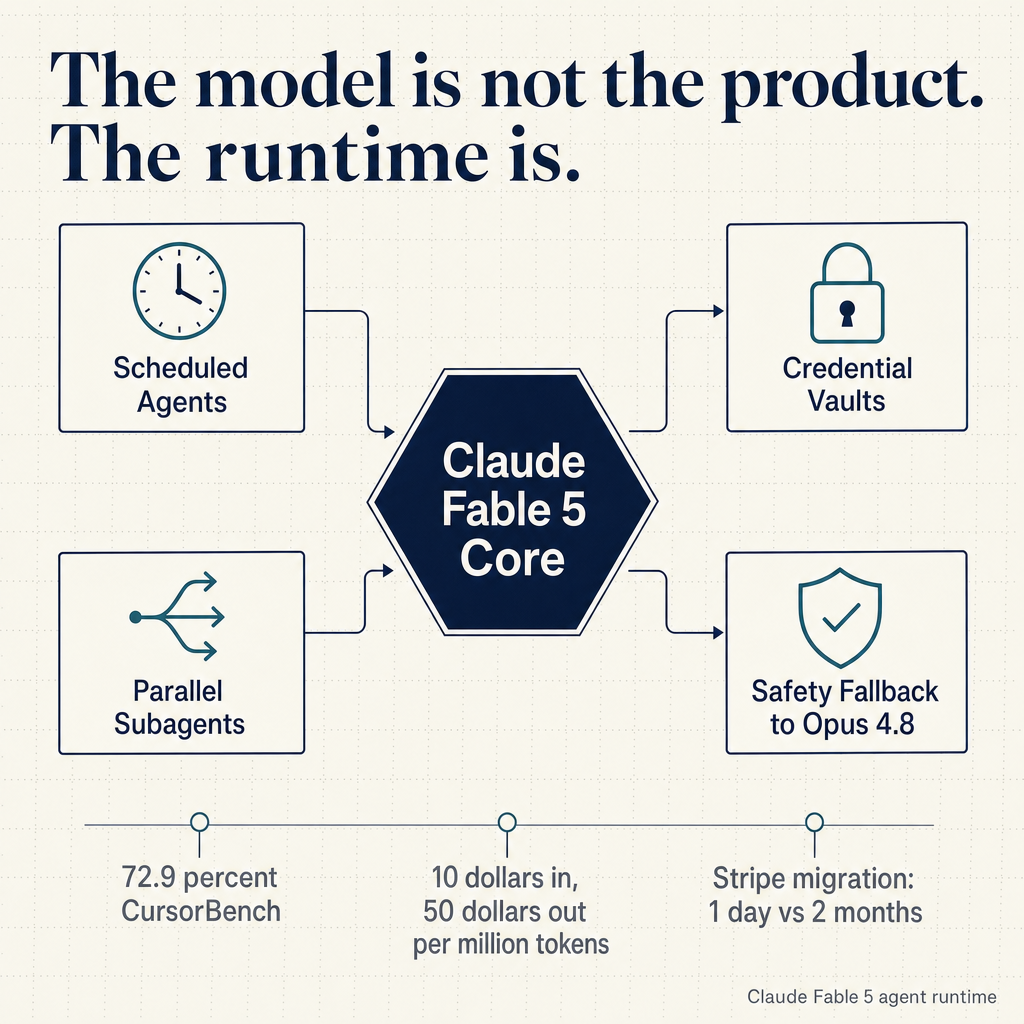
Anthropic released Claude Fable 5 today, and while the benchmark numbers are strong, the more interesting story is that Stripe used it to run a full codebase migration in a single day, work that previously took more than two months. That single data point captures what changed in this release better than any leaderboard score.
The headline numbers are still worth noting. Fable 5 hit 72.9 percent on CursorBench, 8 points above the prior frontier, and Hex reported 10 to 15 percent higher scores on complex data analysis workloads. Pricing comes in at $10 per million input tokens and $50 per million output tokens, roughly twice the cost of Opus 4.8. That premium is steep, but for teams shipping migrations in a day instead of a quarter, the math works out quickly.
What actually shifts the ground is everything Anthropic shipped around the model. Scheduled Claude agents can now run on cron, which means recurring background work no longer needs a wrapper service to trigger it. Encrypted credential vaults let agents hold API keys for downstream systems without exposing them in prompts or logs. Parallel subagents can fan a task out across multiple workers and rejoin the results, which is how a job like the Stripe migration collapses from months to hours. And there is a safety fallback that quietly routes higher risk requests to Opus 4.8 in under five percent of sessions, giving teams a defensible behavior model without having to build the routing themselves.
For builders, this is the part that matters. For roughly two years the central question has been which model to pick for a given task. From this release forward, the question becomes which schedule, which vault, which subagent graph, which fallback policy. The model is no longer the product you are choosing. The agent runtime is. That changes how teams should think about lock in too, because runtime primitives like vaults and scheduling are stickier than model weights. A team that builds its workflow around Anthropic's vault and subagent model is harder to migrate than a team that just calls a completions endpoint.
The thing worth watching is whether OpenAI and Google respond with their own runtime primitives or whether they cede that layer to frameworks like LangGraph and Temporal. If the major labs all ship runtimes, we get a fragmented era where each provider has its own scheduling and credential semantics. If they do not, an independent runtime layer becomes the most valuable piece of infrastructure in the stack. Either way, the agent runtime is where the next round of platform competition gets fought, and Fable 5 is the first release that makes that completely obvious.