Apple unveiled Siri AI at Tim Cook's final WWDC, and the assistant is partly powered by Goog...
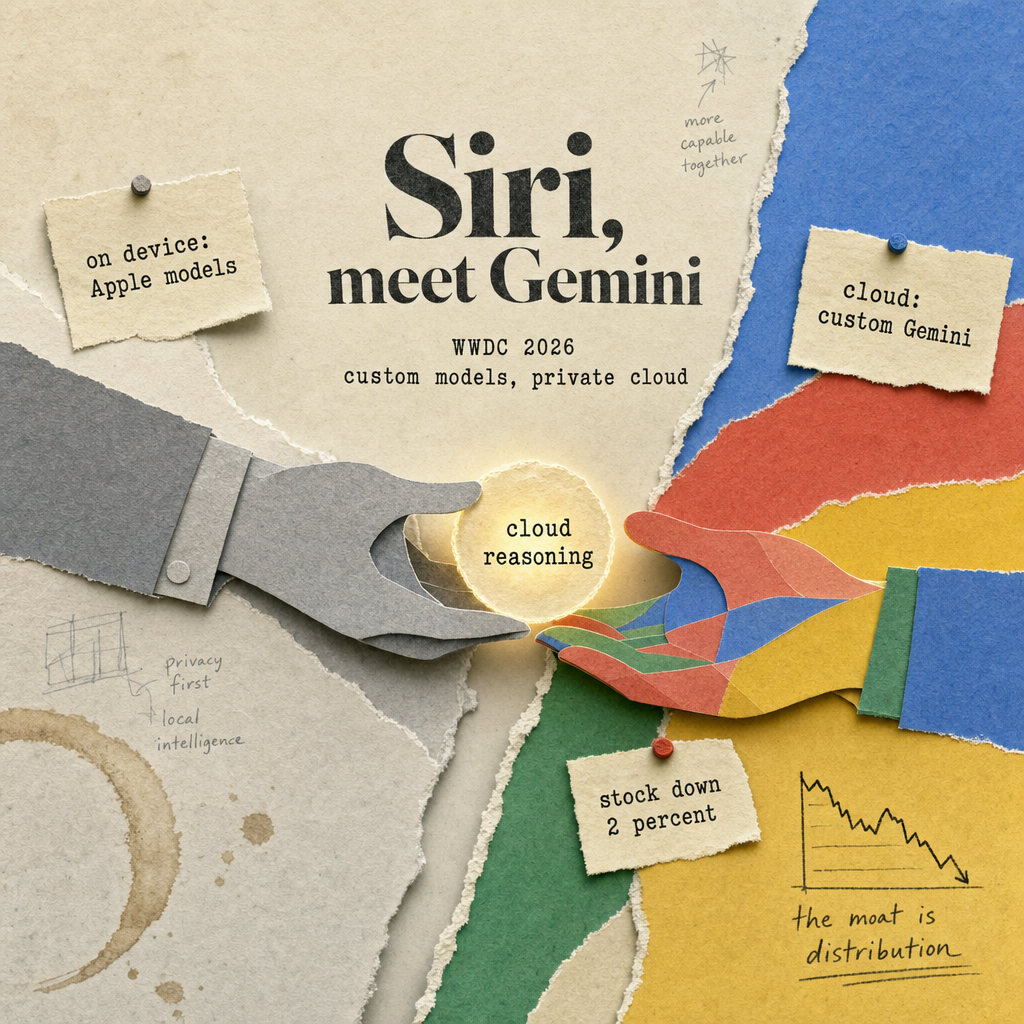
Apple used what turned out to be Tim Cook's final WWDC to unveil a rebuilt Siri AI, and the most surprising detail was not on stage. The new assistant is partly powered by custom Google Gemini models running inside Apple's private cloud, which is the clearest admission yet that Apple could not catch the frontier on its own.
This is the rebuild Apple promised two years ago, when Apple Intelligence shipped and underdelivered against the demos. The new Siri gets its own chatbot style app, can read your on screen content, pulls context from Messages, Mail, and Photos, and can take actions across apps rather than just answering questions. Image generation comes with daily limits because of compute constraints, which is itself a small tell about how tight the serving economics are even for a company with Apple's resources.
The architectural twist, confirmed by Mark Gurman's reporting, is that Apple is using custom Gemini models from Google, not the same versions Google ships to its own users. Apple's own foundation models handle the on device work, where latency and privacy matter most, while Gemini handles the heavier cloud reasoning that runs in Apple's Private Cloud Compute environment. In practice this means your iPhone is doing the lightweight inference locally, and the harder questions are quietly routed to a Google model that Apple has negotiated for and isolated from Google's own infrastructure.
Why this matters goes beyond the product. Apple just publicly admitted it could not build a competitive frontier model in house, at least not on the timeline its customers expect. The company that built its brand on owning the full stack, from silicon to OS to services, is now renting intelligence from its biggest search rival, the same company it takes roughly 20 billion dollars a year from for default search placement. Wall Street noticed and the stock dropped 2 percent on the day.
The bigger signal is for everyone else trying to build in this space. If Apple, with its cash pile, its silicon team, and its data advantages, cannot ship a frontier model alone, then the model layer is consolidating faster than most people assumed a year ago. The expensive part of AI is becoming a utility, and the moat is shifting to distribution, hardware integration, and the user relationship.
What is worth watching next is how this deal ages. Apple has historically replaced partners once it can do the work itself, the way it eventually replaced Intel and Imagination. If Gemini inside Siri is a bridge to Apple's own frontier model, this is a two year story. If it becomes permanent, it is the moment Apple stopped pretending it would own every layer of the stack.
Originally posted on LinkedIn.