NVIDIA just dropped the Isaac GR00T Reference Humanoid, an open hardware and software platfo...
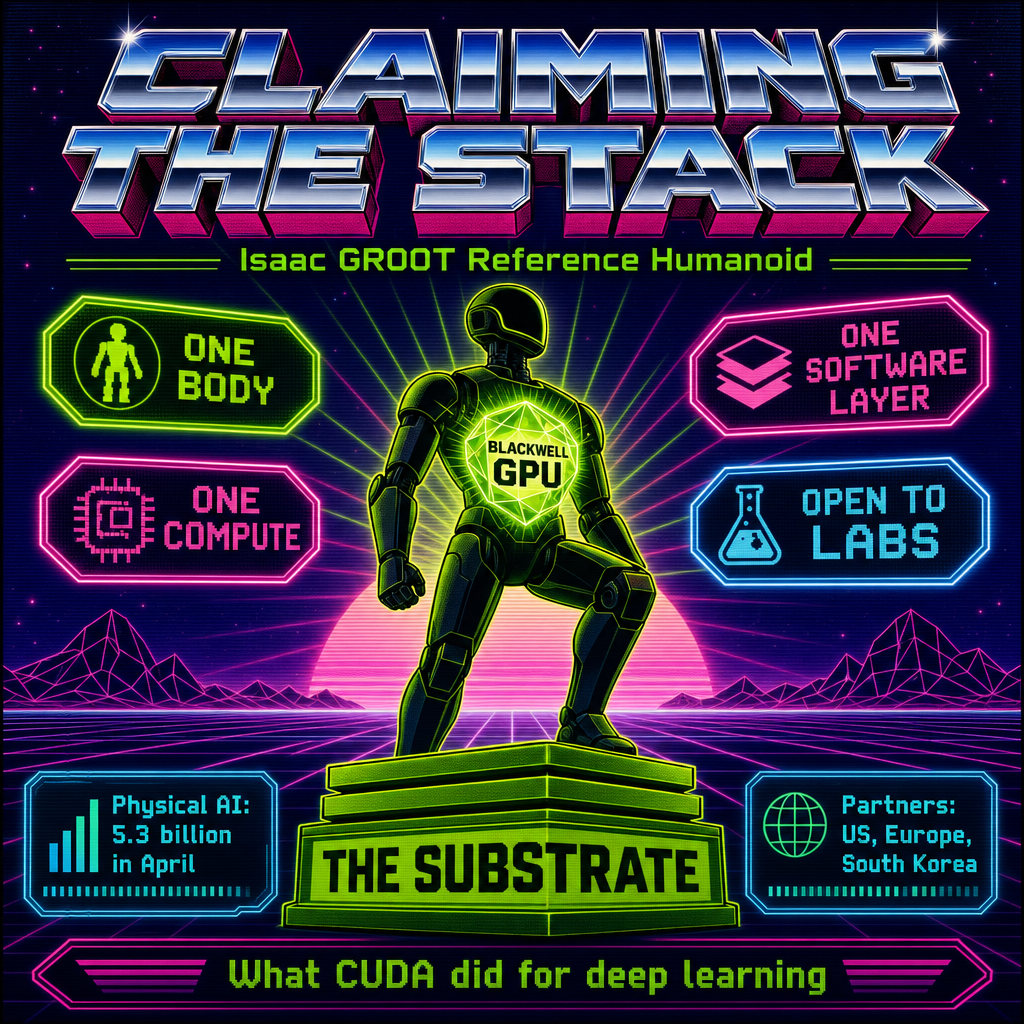
NVIDIA announced the Isaac GR00T Reference Humanoid this week, an open hardware and software platform built jointly with China's Unitree that aims to put a common humanoid research rig into university labs. For anyone tracking how robotics research gets done, this is the kind of move that quietly resets the baseline for an entire field.
The robot pairs a Unitree H2 body with an onboard Blackwell GPU. One body, one compute stack, one software layer that any research group working on humanoids can build on. NVIDIA also said it will extend the reference design beyond Unitree to partners in the US, Europe, and South Korea, which signals that this is not a one off collaboration but the start of a broader hardware program. The choice of Unitree as the first partner is notable on its own, given how aggressively Chinese humanoid makers have driven down hardware costs over the past two years.
Why does this matter technically. Humanoid research has been bottlenecked by hardware fragmentation. Every lab builds on a different body with a different controller, so skills learned on one robot do not transfer to another, and reproducibility suffers. A shared reference design with a Blackwell GPU on board means simulation, training, and deployment can finally live on the same stack. Policies trained in Isaac Sim can be expected to run on the same compute that ships inside the robot, which closes a loop that has historically been painful for research teams.
Why it matters strategically is the larger story. NVIDIA is doing for humanoids what CUDA did for deep learning, owning the substrate everyone else builds on. Sam Altman is quietly backing robotics startup Alfred, and physical AI startups pulled in 5.3 billion dollars in April alone. The platform layer is being claimed right now, while attention is still mostly on language models, and the company that wins the developer mindshare in humanoid robotics in 2025 and 2026 will likely set the defaults for a decade. If humanoid robots become real products this decade, the stack underneath will likely be green.
The piece worth watching next is which university labs actually adopt the reference design, and whether the standardization holds once partners in other regions ship their own variants. CUDA became dominant because the alternatives were genuinely worse and the ecosystem compounded over years of patient investment. Isaac GR00T is at a much earlier stage, but the structural play is the same. If a generation of robotics PhDs trains, publishes, and ships on this stack, the lock in will be hard to undo, regardless of which body manufacturer eventually wins the consumer market.
Originally posted on LinkedIn.