Google just launched Dreambeans, an app that turns your Gmail, Calendar, Photos, YouTube, an...
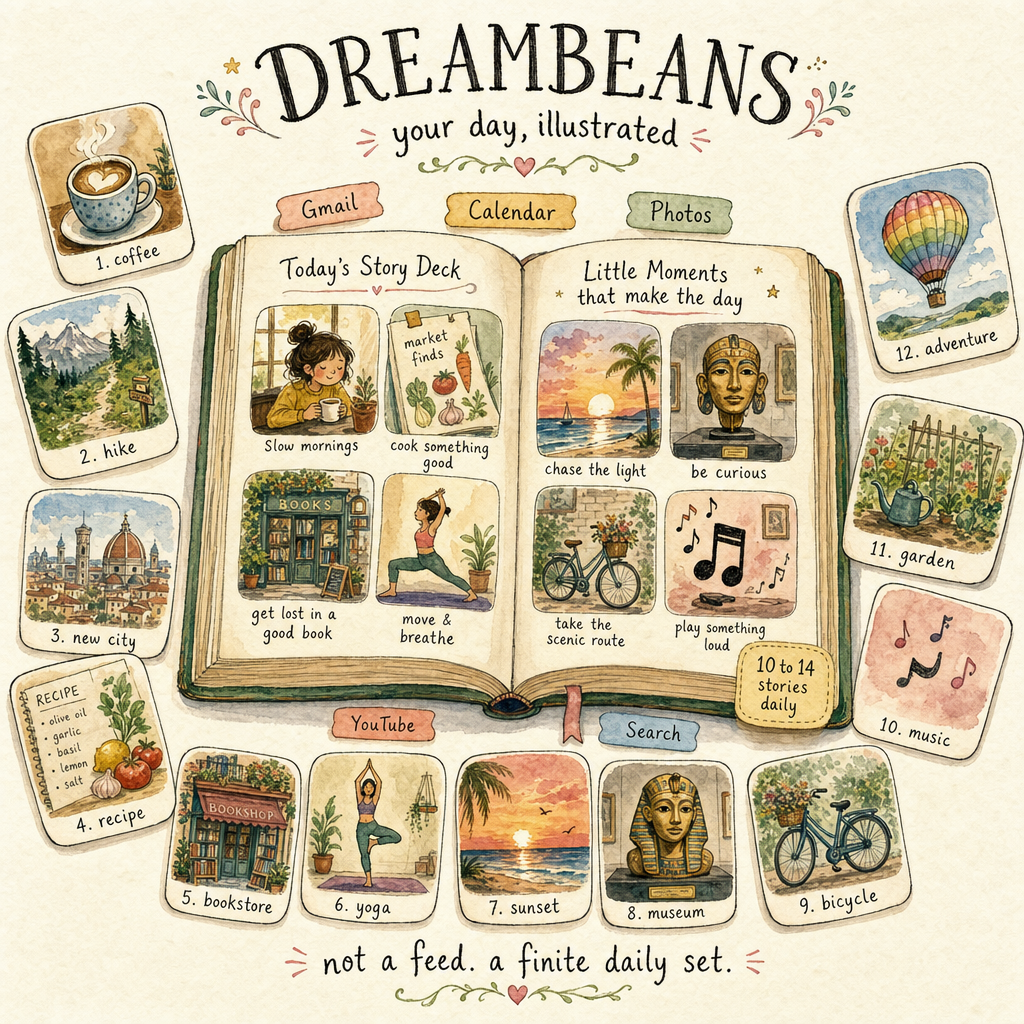
Google quietly shipped something unusual through its Labs division this week. Dreambeans is a personalized app that pulls from your Gmail, Calendar, Photos, YouTube, and Search history to generate a daily set of illustrated stories about your life and interests, and it matters because it is the first time a major platform has treated your personal data as a creative input rather than an ad targeting signal.
The format is the opposite of a feed. Instead of infinite scroll, Dreambeans caps the output at roughly 10 to 14 cartoon style stories per day. These are framed as places to visit, topics to explore, things to try, and travel ideas, all stitched together from signals Google already has on you. Once you have read through the day's set, the app stops. There is nothing else to refresh into.
The technical bet underneath this is what makes it interesting. Most consumer AI today is reactive. You prompt a model, it responds, and the interaction ends when you close the tab. Dreambeans flips that loop. It reaches into your private context without being asked, generates illustrated outputs on a schedule, then deliberately limits how much it produces. That kind of bounded, proactive generation is a design pattern we have not really seen at scale in consumer products, and it requires the model to make editorial choices about what is worth surfacing from a noisy personal corpus.
The design choice carries weight given who is shipping it. Google built much of the modern attention economy, and now it is releasing an app whose pitch is essentially, here are your ideas for the day, now go live it. Whether that framing holds up in practice or slowly drifts toward engagement maximization is an open question, but the initial posture is notable.
The privacy trade is real and worth thinking through carefully. You choose which Google services to connect, you can delete your data, and the generated stories stay private rather than being shared or used as ad signals. Even so, the model needs broad access to your account surfaces to produce anything useful. The quality of the output is directly tied to how much of yourself you hand over, which is a tension the product cannot fully resolve.
What I want to watch next is whether other companies follow this pattern of bounded, proactive, personal AI, or whether Dreambeans stays a Labs curiosity. If the format works, it suggests a different shape for consumer AI than the chatbot paradigm we have been stuck inside for two years. If it does not, it will be a useful data point about how much agency people actually want from their assistants, and how comfortable they are letting a model rummage through their digital life on its own schedule.
Originally posted on LinkedIn.