Microsoft just shipped seven in house MAI models at Build 2026, finally writing an AI story...
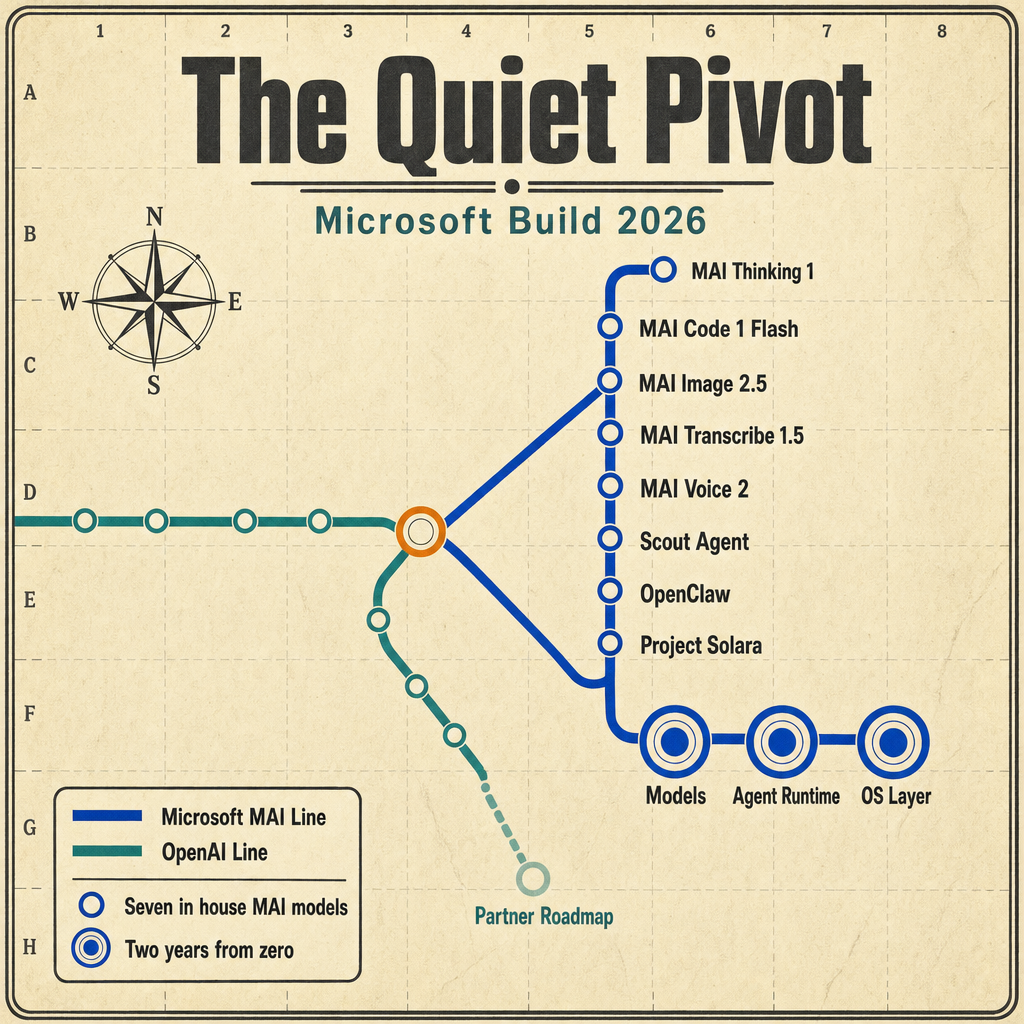
At Build 2026 this week, Microsoft introduced seven models built entirely in house under the MAI brand, a quiet but pointed signal that the company is no longer content to be the distribution arm for OpenAI. For anyone tracking how the agent era will actually be built, this is the moment Microsoft started laying its own rails instead of renting someone else's.
The lineup spans reasoning, code, image, voice, and transcription, led by MAI Thinking 1, MAI Code 1 Flash, MAI Image 2.5, MAI Transcribe 1.5, and MAI Voice 2. All of them are from scratch pretrains, and all of them ship through Microsoft Foundry, the company's model and agent platform. The breadth matters as much as the quality. Microsoft did not pick one modality and try to win it. They shipped a full stack family in a single keynote.
This pace is what makes the announcement unusual. The Microsoft Inflection deal that effectively created the MAI team happened just two years ago. Going from zero to a credible tier two model family in that window, with a technical report over 100 pages that the research community is actually praising for its detail on data, training, and evaluation, is not a normal outcome. Most internal model efforts at this scale take longer and ship quieter.
The strategic picture sharpens when you add the other Build announcements. Microsoft also debuted Scout, an always on agent built on a runtime called OpenClaw, along with Project Solara, an agent first hardware effort. Stack the pieces together and the play is clear. Models, agent runtime, and the operating system layer, all owned by Microsoft. That is a full vertical, not a partnership dependency. It is also notable that while several frontier labs have effectively killed finetuning for their flagship models, MAI is leaning into domain specific tuning as a first class feature, which is a direct appeal to enterprise customers who want to shape models around their own data.
What to watch from here is how this changes the OpenAI relationship in practice. The contractual ties remain, and Microsoft will keep distributing OpenAI models through Azure for the foreseeable future, but the incentive structure has shifted. When the same company sells you the model, the agent runtime, the hardware, and the cloud, it has every reason to push customers toward its own stack over time. The interesting question for the next year is whether MAI can close the gap with frontier labs on raw capability, or whether Microsoft is betting that good enough models plus tighter integration will win the enterprise agent market regardless.
Originally posted on LinkedIn.