Waymo just launched the Ojai, its first purpose built robotaxi, and the engineering choice b...
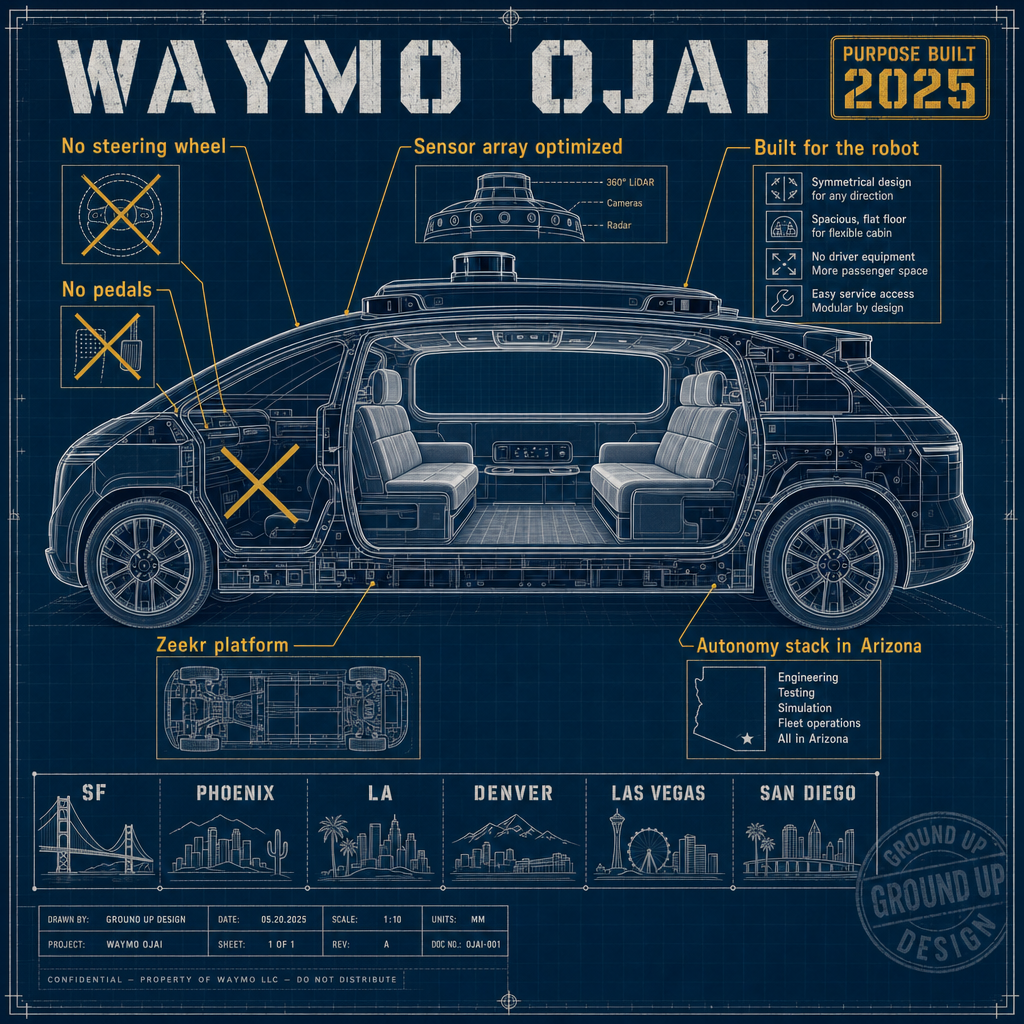
Waymo just unveiled the Ojai, its first robotaxi designed from scratch for a world without a driver. Every Waymo on the road until now has been a retrofit, a human driven car with autonomy bolted on, and the shift to a clean sheet design signals that the robotaxi industry is moving past the proof of concept phase into something more committed.
Until now, every Waymo you have seen started life as a human driven vehicle. Steering wheel, pedals, mirrors, all the legacy hardware of a car built for a person. The Ojai throws that away entirely. It was designed from the ground up for a world with no driver, which changes what the cabin can be and how the autonomy hardware integrates with the body of the vehicle itself.
The Ojai is built on a platform from Geely's Zeekr brand, manufactured in China, with Waymo's autonomous systems added in Arizona. That split supply chain is interesting on its own given current trade dynamics, but Waymo seems to have decided the platform advantage is worth the complexity. Rides launch in San Francisco, Phoenix, and Los Angeles in the coming weeks, with Denver, Las Vegas, and San Diego to follow shortly after.
Here is why this matters technically. When you co design the vehicle and the autonomy stack together, you stop fighting the car. Sensor placement, compute routing, thermal management, cabin layout, all of it gets optimized for the robot rather than retrofitted around a human driver's seat. Purpose built hardware and purpose built software compound each other, and the savings show up in unit economics, in service uptime, and in how cleanly the sensors can see the world around the vehicle. A Jaguar I Pace with a sensor rack on the roof is a compromise. The Ojai does not have to be.
This is the same inflection point that happened in smartphones. The first mobile internet devices were laptops with cellular chips bolted on. Then someone asked what a phone designed purely for the internet would look like, and the answer reshaped an industry. The Ojai is that question applied to transportation, and it arrives at a moment when Waymo is the only US operator running paid driverless rides at meaningful scale.
What to watch next is whether the unit economics actually improve enough to justify the manufacturing investment, and whether competitors like Zoox and Tesla can ship purpose built vehicles on a comparable timeline. The interesting design question is also what happens to the cabin when no one needs to face forward or watch the road. That is the real space, both literal and conceptual, that the Ojai opens up.
Originally posted on LinkedIn.