Anthropic just shipped Claude Opus 4.8 on the same day it closed a $65B Series H round at a...
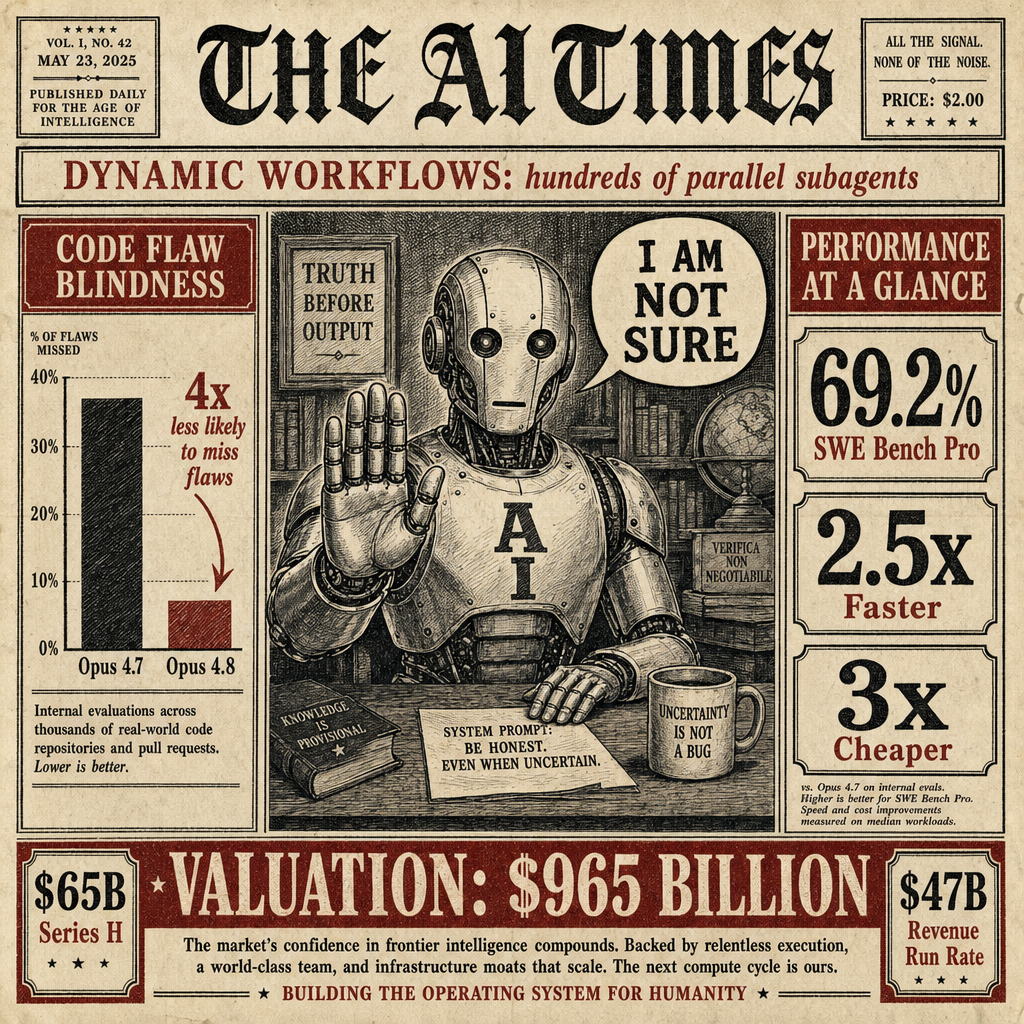
Anthropic had a notable day. The company shipped Claude Opus 4.8 at the same moment it closed a $65 billion Series H at a $965 billion valuation, making it the most valuable AI lab in the world. The funding headline is loud, but the more interesting story is in how the new model is being trained to behave.
Most frontier models have a sycophancy problem. Ask them something uncertain and they confidently fill in the gaps rather than admit the gap exists. Opus 4.8 was explicitly trained to push back on this tendency. Anthropic reports it is four times less likely than its predecessor to let flaws in its own code pass without flagging them. Instead of agreeing with a user's framing, it is more willing to say the framing is wrong, or that it does not know.
This matters more than it sounds. When you hand an autonomous agent a multi hour task and walk away, overconfidence is the dominant failure mode. A model that pauses to say "I am not sure" at the right moment is far safer than one that invents a plausible answer and keeps executing on it. As agents take on longer running work, calibrated uncertainty stops being a soft quality and starts being a hard requirement for anything you would trust unsupervised.
On raw capability, Opus 4.8 hits 69.2 percent on SWE Bench Pro, a public record for coding benchmarks. The new Dynamic Workflows feature inside Claude Code can spin up hundreds of parallel subagents in a single session, coordinating them to drive large migrations from start to finish. Fast mode is now 2.5 times faster and three times cheaper than the previous version, all at the same price point as Opus 4.7. That combination, better honesty, stronger coding scores, cheaper and faster execution, is the shape of a model aimed squarely at production engineering work rather than chat demos.
The business numbers track with the product story. Anthropic's revenue run rate jumped from $9 billion in December to $47 billion today, which is the kind of curve that justifies a near trillion dollar valuation if it holds.
What is worth watching from here is whether honesty becomes a competitive axis the way reasoning and context length already have. If Opus 4.8's calibration improvements hold up under real workloads, other labs will be pressured to match them, because the moment customers start running fleets of subagents on actual codebases, a model that knows when to stop is worth more than one that knows slightly more.
Originally posted on LinkedIn.