Biohub just released ESMFold2, a world model of protein biology, and the implications for me...
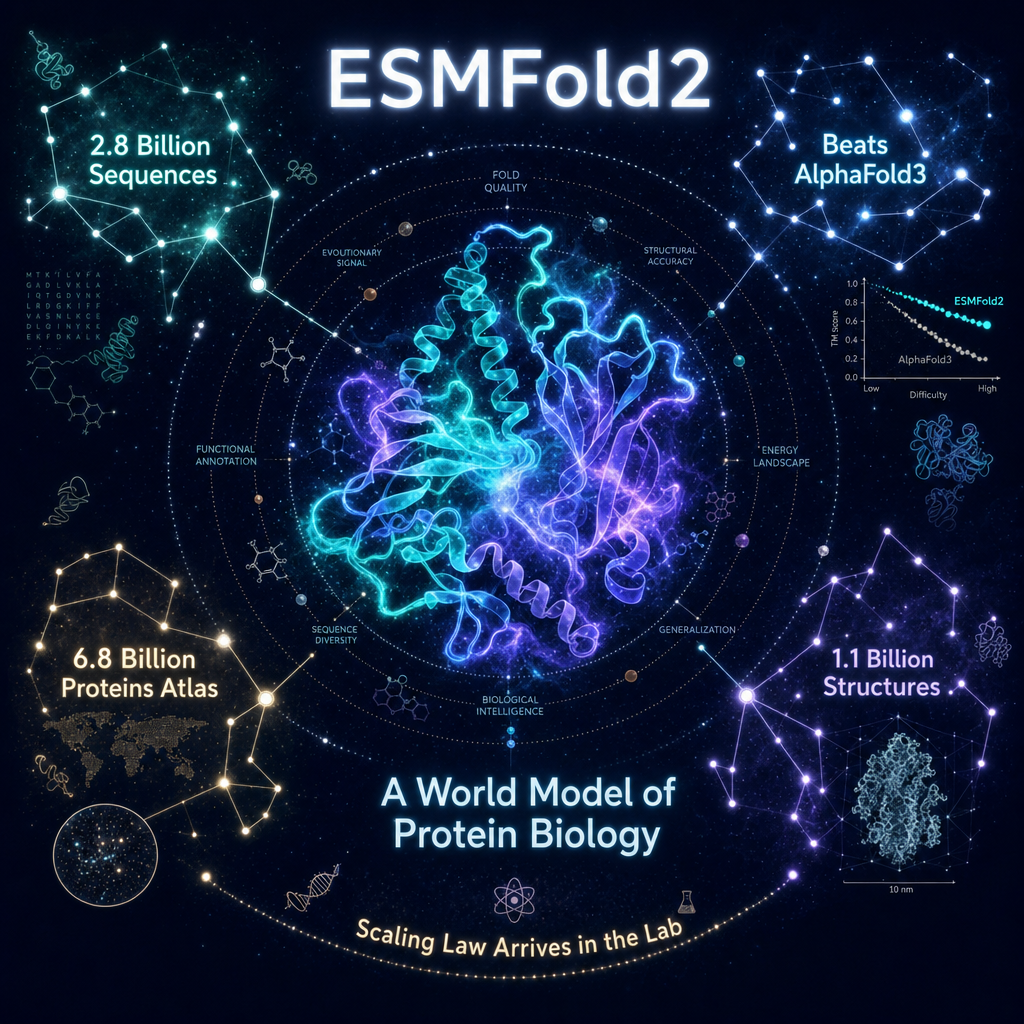
This week the Chan Zuckerberg Biohub released ESMFold2, an open protein world model that pushes past structure prediction into protein design and interaction modeling. For anyone tracking how AI is reshaping drug discovery, this is one of the clearest signals yet that the scaling playbook from language models is now running inside biology labs.
Biohub, the nonprofit funded by Mark Zuckerberg and Priscilla Chan and led by scientist Alex Rives, dropped ESMFold2 alongside a sizable open data release. The model is built on ESMC, a protein language model trained on 2.8 billion sequences. What you get is a single open system that can predict protein structure, design new proteins from scratch, and model how proteins interact with each other. Previous releases in this lineage focused mostly on folding. ESMFold2 widens the scope into the territory where actual therapeutic work happens.
The technical leap is worth slowing down on. Earlier protein models were typically trained to solve one narrow problem, like predicting a structure from a sequence. ESMFold2 instead treats protein sequences the way a language model treats words and sentences. Feed it enough sequences and it starts to learn biology itself, including structure, function, and interactions that were never explicitly part of any training objective. The team reports it beats AlphaFold3 on some of the hardest antibody prediction tasks, which sit at the center of modern drug design. Antibodies are notoriously tricky because their binding regions are highly variable, so a measurable win there is not a small thing.
Alongside the model, Biohub released an atlas of 6.8 billion proteins and 1.1 billion predicted structures, all open to researchers. That kind of open release matters because it lowers the floor for academic groups and smaller biotechs who cannot afford to generate that data themselves. It also creates a shared substrate that other labs can build on, which tends to accelerate the rate of follow on work.
The broader pattern here is the one worth sitting with. The same scaling logic that made ChatGPT more capable by training on more text is now making biology models more capable by training on more protein sequences. The bitter lesson from language AI, that general methods plus more data tend to beat handcrafted approaches, is arriving in the wet lab. What to watch next is whether this generalizes to harder problems like protein protein complexes, small molecule binding, and eventually full cellular dynamics. If it does, the bottleneck in drug discovery shifts from computational prediction to experimental validation, and the institutions that win will be the ones that can run biology at the pace AI now proposes hypotheses.
Originally posted on LinkedIn.