A research paper from Sapient Intelligence argues that Chain of Thought reasoning, the techn...
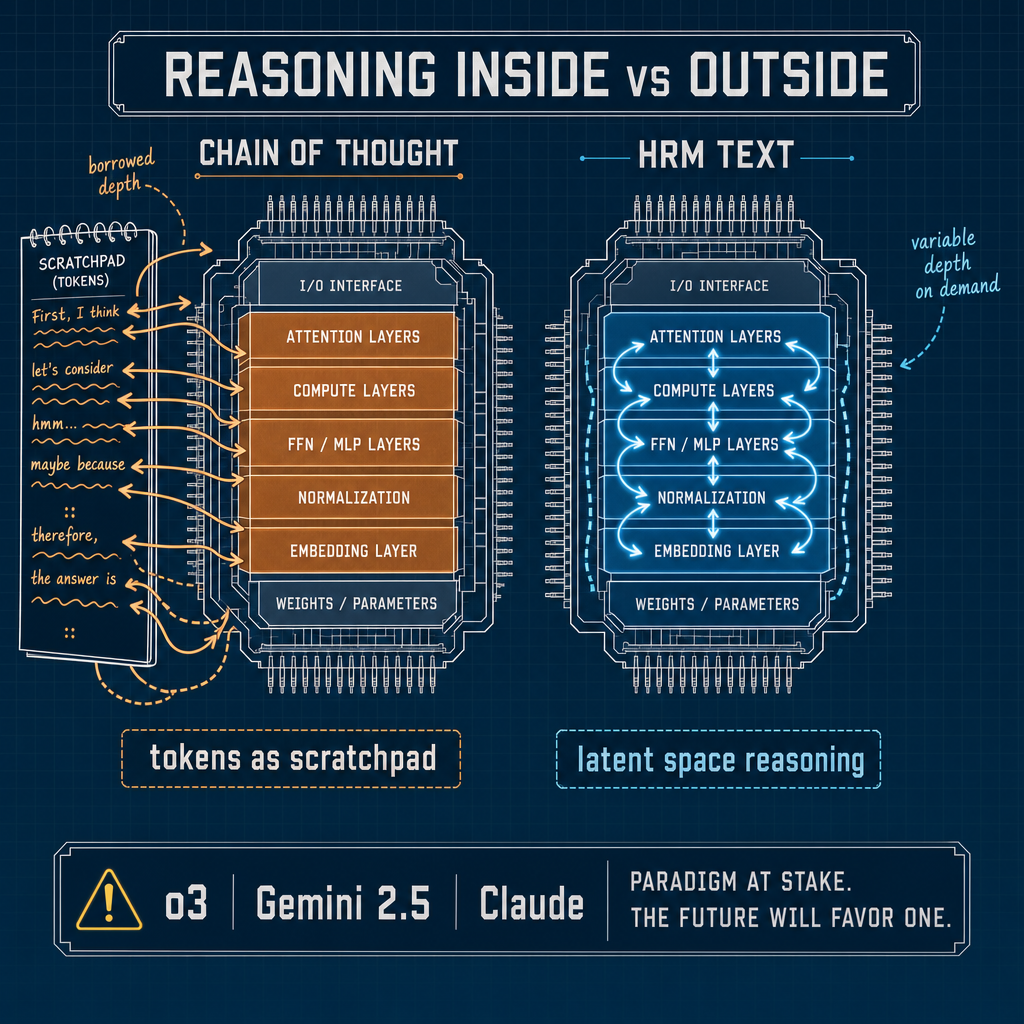
A research paper from Sapient Intelligence is making the case that Chain of Thought reasoning, the technique behind nearly every advanced AI system shipping today, is architecturally broken. If they are right, the foundation under models like o3, Gemini 2.5, and Claude is shakier than the benchmark numbers suggest.
The core idea is worth slowing down on. Modern large language models are fixed depth. A 70 layer Transformer processes your input in one forward pass, and that depth puts a hard ceiling on the complexity of problems it can solve in a single shot. To get around this, labs invented a workaround. They taught models to think out loud, step by step, token by token. We call it Chain of Thought, and it is the engine behind almost every reasoning benchmark improvement of the last two years.
Sapient's argument is that this is the equivalent of a CPU that must print every intermediate calculation to a notepad before it can use it again. The model is borrowing computational depth from its own output, spilling internal work into human readable tokens, then feeding that text back in to continue reasoning. It works, clearly, but it is inefficient, it is slow at inference, and it is fragile in the sense that one bad token in the chain can derail the entire trajectory. It also explains why reasoning costs at the API level have climbed so sharply. You are paying for the model to externalize its own thinking.
Their alternative is called HRM Text, and it keeps reasoning inside the latent space. The model works through problems at the level of internal activations rather than visible words. No scratchpad, no token by token externalization, and crucially, variable depth on demand. The model can iterate internally as many times as the problem requires before committing to an output. In principle this matches how a real CPU operates, holding intermediate state in registers rather than printing it to a screen.
Early results are promising but not yet conclusive at scale. The real question is whether HRM Text can match or beat CoT on the hard reasoning benchmarks where Chain of Thought currently dominates, things like advanced math, code generation, and multi step planning. Sapient's published results are encouraging on smaller tasks, but the field has seen plenty of architectures that looked clean in papers and stalled when scaled.
What to watch over the next several months is whether any frontier lab adopts a latent reasoning approach in production, or whether HRM Text style ideas start appearing in open weights releases. If latent reasoning proves out at scale, the entire paradigm of paying per reasoning token, of watching models think in plain English, of debugging chains of thought, may turn out to have been a transitional phase rather than the destination.
Originally posted on LinkedIn.