Google's I/O 2026 didn't just ship new models.
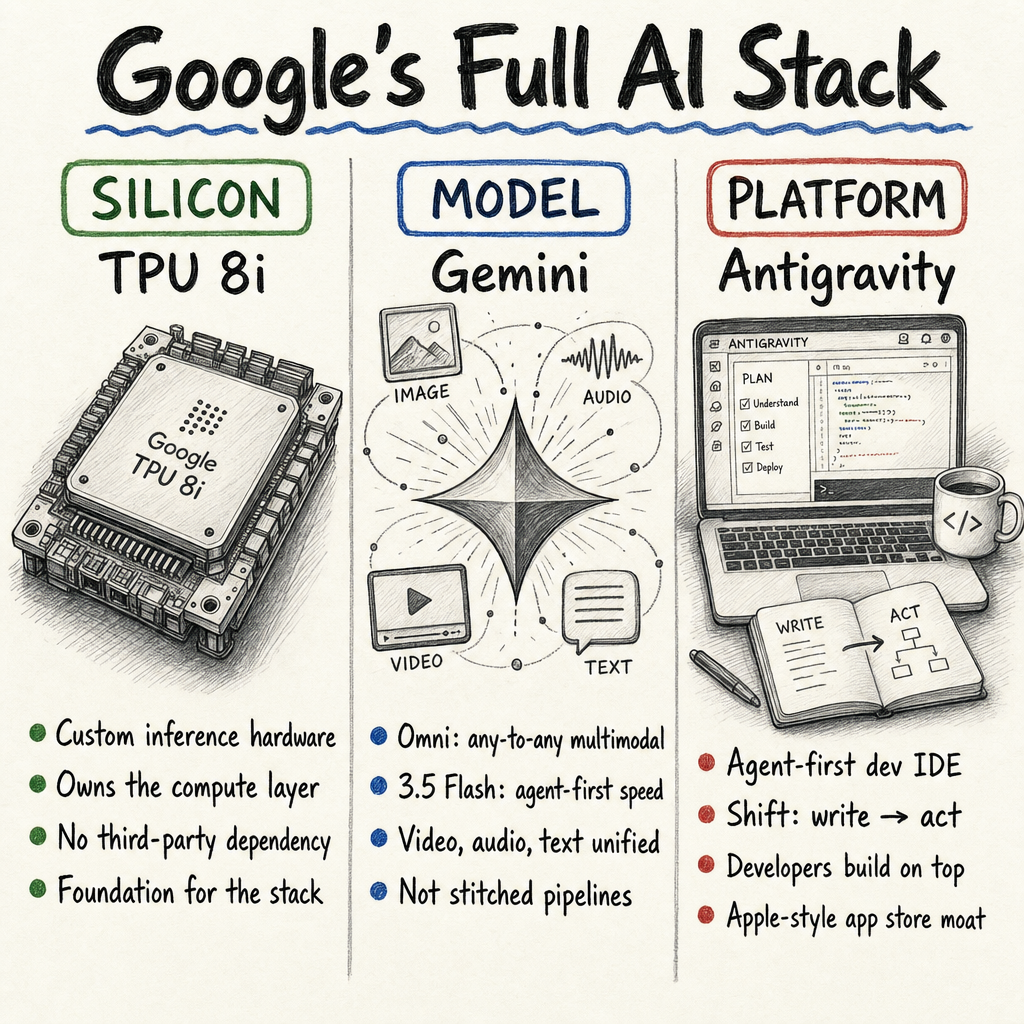
Google's I/O 2026 keynote landed less as a model launch and more as a strategy reveal. The company used the event to show that it now controls every layer of the agentic AI stack, from custom silicon up to the developer environment, and that integration is what makes the announcements add up to something bigger than their parts.
The headline release was Gemini Omni, an any to any model that handles video, audio, and text inside a single system. This is real multimodal editing rather than the stitched together pipelines that most current tools rely on, where a vision model hands off to a language model which hands off to a generation model. Collapsing that into one system removes the latency and quality loss that comes from passing intermediate representations between separate networks.
The more consequential announcement, though, was Gemini 3.5 Flash paired with Google Antigravity, a new agent first development platform. The framing shifted noticeably, from AI that helps you write code to agents that help you act on systems. Antigravity is designed around the assumption that the developer is supervising agents rather than typing, which is a meaningful redesign of what an IDE is for. Underneath all of this sits the new TPU 8i, Google's latest custom inference chip, which means Google now controls the full chain from silicon through model through the tools developers actually open each morning.
No other frontier lab has shipped something this coherent this year. OpenAI has models. Meta has models. Google now has a system, and the difference shows up in how the pieces reinforce each other. This is what vertical integration looks like in AI. The closest analogy is Apple owning chip, operating system, and app store, where each layer is tuned for the others and competitors have to match the whole stack rather than any single component. Google is building toward owning inference hardware, model, and the platform developers build on top of. That is a different kind of moat than topping a benchmark.
The thing worth watching over the next year is whether Anthropic and OpenAI can answer at the infrastructure layer or whether they remain dependent on third party compute and third party IDEs. Anthropic has deep ties to Amazon and Google for compute, and OpenAI's relationship with Microsoft gives it Azure and a foothold in VS Code, but neither owns the chip and neither owns the IDE outright. If agentic workflows become the dominant way developers ship software, the lab that controls the surface where those agents run may end up with structural advantages that are hard to price into a model comparison chart.
Originally posted on LinkedIn.