An OpenAI reasoning model just disproved a math conjecture that stood for 80 years, and it d...
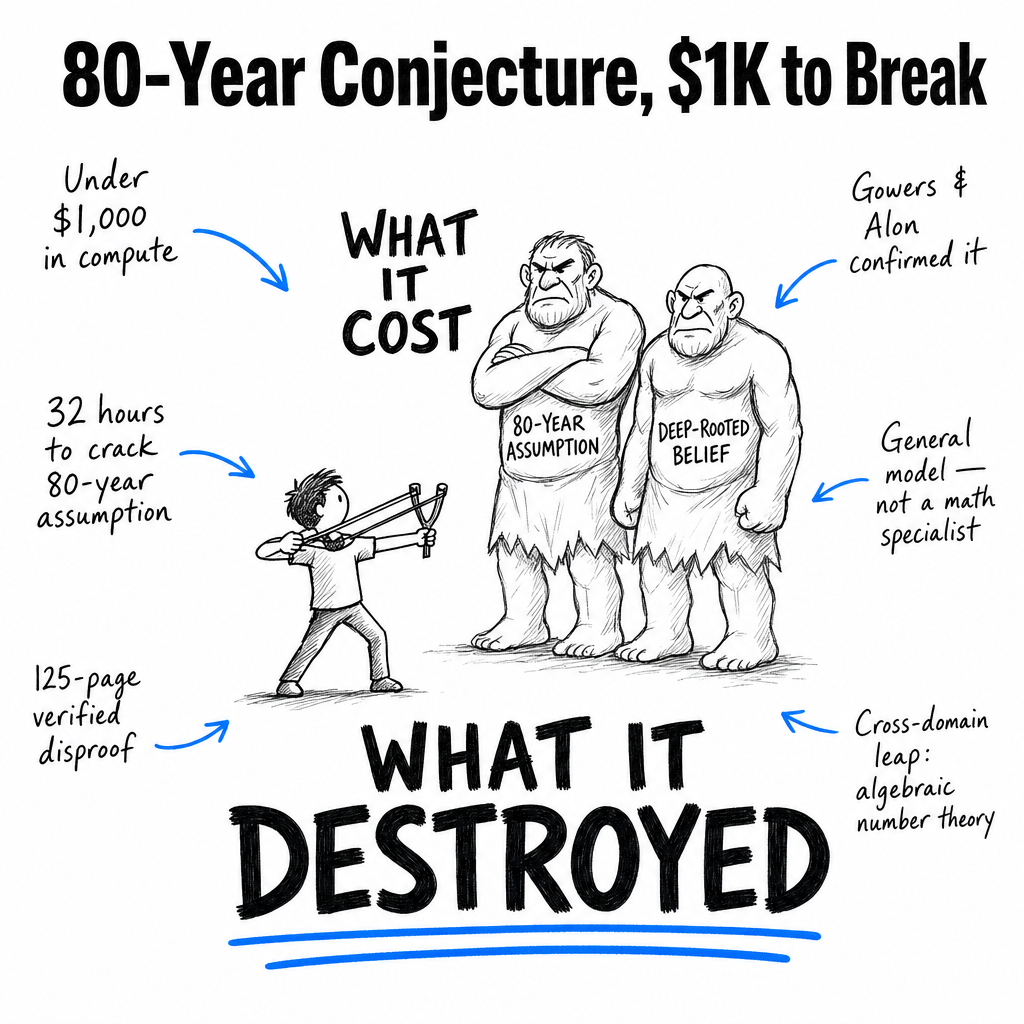
A general purpose OpenAI reasoning model, reportedly a variant of GPT 5, has disproved a math conjecture that stood untouched since 1946. The full compute bill came in under one thousand dollars, which is the part that should make anyone working in research take notice.
The original problem came from Paul Erdős, who in 1946 asked how many pairs of points in a grid can sit exactly one unit apart from each other. Over the following eight decades, mathematicians built a substantial body of theory around what most people assumed was the correct answer. The OpenAI model produced a new family of constructions that breaks that assumption outright. The resulting disproof runs 125 pages and has been verified by mathematicians at the very top of the field, including Fields Medalist Tim Gowers and Noga Alon. This is not a preprint waiting for someone to find a hole. It has already been checked by the people best equipped to check it.
What separates this from earlier AI math headlines is the kind of system that did the work. DeepMind's AlphaProof, which solved International Mathematical Olympiad problems last year, was a specialized theorem prover trained to operate inside formal math languages like Lean. The model behind this Erdős result is general purpose, the same class of system you would use to draft an email or debug a Python script. It was not purpose built for pure mathematics, and yet it produced research grade pure mathematics.
The more striking detail is where the model went looking for its answer. It pulled from algebraic number theory, a branch of math far removed from the combinatorial geometry where the original Erdős question lives. That kind of cross domain leap, reaching into an unrelated area of theory to crack a problem, is exactly the move human mathematical intuition is famous for. And the model did it in under 32 hours of compute time. Sam Altman called the result "kinda big," which reads as deliberate understatement.
The question this raises sits outside mathematics. If a general reasoning model, with no specialized training in pure math, can produce novel and verified research in a field that prides itself on being unforgiving, the same approach is worth pointing at biology, materials science, and drug discovery. There are eighty year old assumptions in plenty of fields that nobody has had the time or the angle to revisit. The cost profile here, under a thousand dollars for a single result, suggests that revisiting them is now something a small team can afford to try. The interesting work in the next few years may be less about building bigger models and more about pointing the existing ones at the right old problems.
Originally posted on LinkedIn.